Monday, July 29, 2013

Plant Story: Common mullein and its folklore


mullein, Verbascum thapsus in late summer
common mullein
Verbascum thapsus,
in late summer
    Common mullein, Verbascum thapsus, is a European plant that has made its way all over the world. The USDA plant distribution maps show it in all the U.S. states and all but Arctic Canada. It is a member of the Scrophulariaceae, the snapdragon family.

    The name mullein may be from mollis, Latin for soft, a description of the big hairy leaves, but it is possibly from the Latin malandrium, a disease of cattle, for which mullein was a remedy. There are several points of confusion about common mullein (see below). But clearly it has been known so long that its common name is based on Latin.

    Pliny called the plant verbascum, so apparently that was another name Latin speakers used. Linnaeus adopted Verbascum as the scientific name for the genus.

    The word, thapsus, is the name of a town in north Africa, now Ras Dimas, Tunisia. On April 6, 46 BC, Julius Caesar defeated the forces of Scipio at Thapsus. The battle was fought on the outskirts of the city and the city surrendered shortly thereafter, ending the war against Caesar in Africa. However, when I tried to figure out if that meant that mullein grows in Tunisia, I discovered that en.wikipedia says, convincingly, that thapsus was taken from thapsos, the name of an unidentified plant from Thapsos in Sicily. As far as I can tell the plant has been growing in both areas since prehistoric times. I doubt that it is native to all of Eurasia as the en.wikipedia article says. More probably, long before written history it migrated with humans to all those locations, from some much more limited homeland.

Monday, July 22, 2013

Visiting Northern California: the Coast at Inverness


Beach at Point Reyes National Seashore, California
Dunes, Point Reyes National Seashore, California
Dunes, Point Reyes
National Seashore, California
   Point Reyes National Seashore is a lovely place. When it is unpleasantly hot in St. Louis, Denver, or Walnut Creek, you can head to the beach and find yourself cooled by the breeze off the ocean, and even looking for a windbreaker  when the clouds roll in. 

     We were there in May and we really did have these beaches to ourselves. 
beach at Point Reyes National Seashore, California
beach at Point Reyes


flowers on the headlands, Point Reyes National Seashore, CA
flowers on the headlands,
Point Reyes
   
     The spring wildflowers were glorious. They dotted the headlands with color.

California poppy, Eschscholzia californica
California poppy,
Eschscholzia californica 

Monday, July 15, 2013

Botany Rules 6: Ongoing Issues--Acacia


Acacia koa, Hawaii
Acacia koa, Hawaii
    I have been writing how the rules for plant names are made and how they are changed. The rules and changes are made by people. But people rarely all agree. Controversial issues dividing the members of the International Association of Plant Taxonomists (IAPT) keep cropping up. 

    The current problem is the acacias. Acacias are trees and shrubs found in the Americas, Africa and Australia, with a few in southern Asia and on islands around the world. Historically they were in one huge genus with 1,540 species, the genus Acacia

    It has been clear for more than a decade that the acacias are not a single group but rather five groups of similar-looking plants. The subgroups (subgenera) of Acacia are being renamed as genera in their own right, bringing the names into line with the evidence, which is both molecular and morphological. 

    The problem was and is: which plants get to be called Acacia

Monday, July 8, 2013

Botany Rules 5: New Rules Allowing Descriptions in Latin or English

acacia in Australia
acacia in Australia
  I wrote last time about the IAPT--International Association of Plant Taxonomists--the group that set up the rules of plant names. Changes are proposed and the rules gradually change. Many rules go back decades but the work of the International Association of Plant Taxonomists goes on. 

   The big news from the International Botanical Congress held in Melbourne Australia in 2011 was that the IAPT changed the rule that required the official description of a new plant to be in Latin. When Linnaeus set up our taxonomic system, he wrote in Latin. For centuries, new plants and animals were described in Latin. 

Monday, July 1, 2013

Botany Rules 4: Who Makes the Rules?

Nasturtium officinale
NOT Nasturtium nasturtium-aquaticum
     Why is it Nasturtium officinale not Nasturtium nasturtium-aquaticum as some other botanist proposed?

    Who makes the rules for plant names?

   The answer is: The International Association of Plant Taxonomists (IAPT) (home page).

Tropaeolum, Tropaeolaceae
Tropaeolum, determined to be
sufficiently different from
other plants that it is the
only genus in family Tropaeolaceae
   The rules for naming plants and for how they are organized into groups are agreed upon by vote of the International Association of Plant Taxonomists. They meet at International Botanical Congresses, about every 6 years. Suggestions and amendments come out of committees, are voted on by mail and then ratified by the membership attending the International Congress. In this way, the rules of plant naming evolve. Current rules: http://www.iapt-taxon.org/nomen/main.php  

     Like all of science, it is a human activity. Like all human activities, therefore, it is subject to quirky human behavior. 

Monday, June 24, 2013

Unrelated Plants: The Strange Case of Nasturtium and Watercress


watercress, Nasturtium officinale
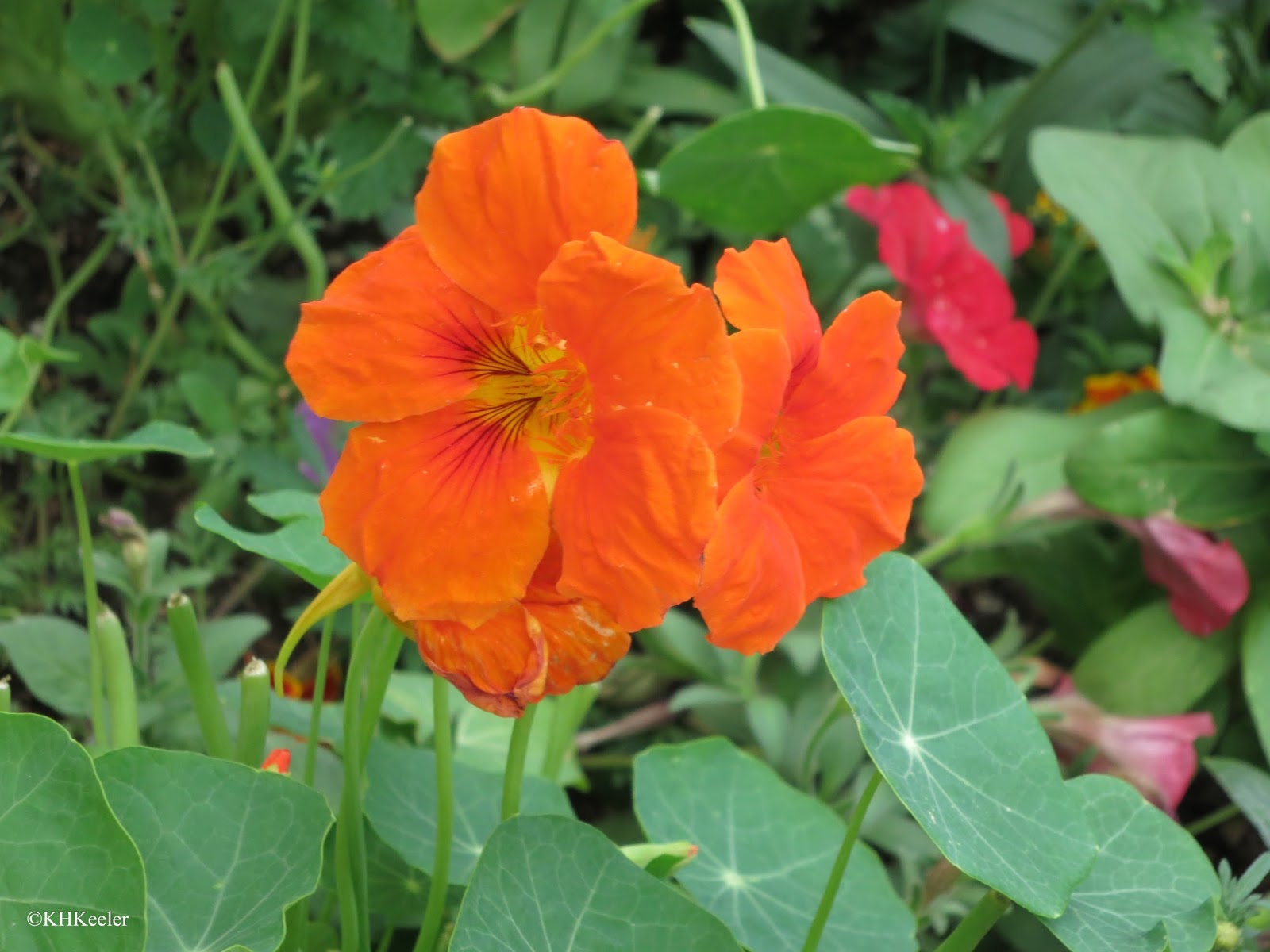
nasturtium, Trapaeolum majus
nasturtium, Tropaeolum majus


     If you have ever looked for nasturtium in the index of plant book, you will have wondered why nasturtium is the scientific name of watercress and the common name of Tropaeolum

    Watercress is a Eurasian plant in the mustard family, Brassicaceae, that has been eaten as a vegetable for centuries. The leaves have a sharp taste. The flowers are white but relatively small and not very conspicuous. It was definitely known to the Romans. Linnaeus named it Nasturtium officinale. It has been called Rorippa nasturtium but current opinion is that it is different enough from the rorippas to be kept separate. Nasturtium nasturtium-aquaticum is another name you will also see for watercress, but Nasturtium officinale has precedence and so is the correct name.

    Nasturtium is a yellow or orange flowered plant, genus Tropaeolum majus (plant family Tropaeolaceae). Nasturtiums are native to the west coast of South America . “[I]t is used as a food in Peru today, as it has been for thousands of years” (Kipple & Ornelas p. 1821).  Tropaeolum was introduced to Europe from the New World in the late 16th century. In the early herbals, for example Gerard, it is called Indian cress.

    Nasturtium is not a common word. It seems odd that nasturtium is Tropaeolum and Nasturtium officinale is watercress. 

Monday, June 17, 2013

Plant Story: small soapweed, Yucca glauca

Yucca glauca in flower
     Standing like candles in the prairie, flowering soapweed yuccas make a handsome display.

A young Yucca glauca
A young Yucca glauca.
You could cover all but the
outer tips of the leaves by
setting down a pop can. 
     Soapweed yucca, Yucca glauca  (asparagus family, Asparagaceae) is found from Canada to Mexico across the central U.S., in areas that before settlement were grasslands.

   Like other yuccas, Y. glauca has a rosette of leaves and can live many years. The plants start as tiny rosettes of short thin leaves and as the plant gets older, the leaves get more numerous and longer.

  The leaves are tough and fibrous, with a sharp point at the tip. Cattle generally avoid eating the leaves. Biologists generally avoid walking where the leaves will stab their legs. The evening volleyball game at Cedar Point Biological Station featured the phrase "stucka by a yucca" for players who ran heedlessly after a stray ball into the plants surrounding the improvised volleyball court.