 |
| Helianthus pumilus, the bush sunflower |
Sunday, July 26, 2015
Plant Story--Helianthus pumilus, the Dwarf Sunflower
"Ordinary" is a point of view. One person's ordinary is another person's rare and exotic observation.
I frequently hike along the trails in the foothills of the Rocky Mountains in Larimer County, Colorado. An ordinary plant growing along the trails is a small sunflower, Helianthus pumilus (daisy family, Asteraceae), called the dwarf sunflower or bush sunflower. It is pretty common on the trails and one quickly ceases to notice it. But, it is endemic to this area and you won't see it more than 250 miles north (Casper WY) or 200 miles south (just southwest of Pueblo, CO). Looking at the specimens recorded by the Rocky Mountain Herbarium (link), it doesn't occur lower than about 5800' or higher than about 8000.' The only place in the world it is an ordinary plant is right here.
Sunday, July 19, 2015
Plant Story--the Exquisite Lotus

Buddha's imagery is an accurate description of the life of lotus plants.

Lotus, also called the sacred lotus, Nelumbo nucifera (lotus family, Nelumbonaceae) has been grown across Asia for millennia. Not just beautiful, it is an important food plant. The leaves, rhizomes ("roots') and seeds are edible (link).
Sunday, July 12, 2015
Visiting Frisia--The Edge of the North Sea
 |
| the Frisian Coast |
I first remember asking that question in reaction to a Great Courses course (link) about the Vikings. The Vikings came out of Scandinavia as raiders about 700 AD. Better ships, more seaworthy on rougher seas, made that possible, but authors only speculate on the social and cultural forces that motivated Scandinavians to become Vikings. Before 700, the people of Scandinavia were thought to be a backwater of Europe. But not really so backward, the course suggested, because they traded with the Frisians who traded with the Romans, so that all manner of Roman Empire technology made its way into Scandinavian villages.
So who were the Frisians? When a tour (National Geographic Expeditions, see details) offered a stop on the Frisian Islands, I was in!
Sunday, July 5, 2015
Visiting Northern Colorado--Fields of Wildflowers!


Sunday, June 28, 2015
Plant Story--Beautiful Blanket Flower, Gaillardia
Blanketflower, Gaillardia, is a native you probably know as a garden flower. Native garden flowers are not all that common.

Recently, talking and writing about garden flowers, I looked at the origins of common garden flowers and noticed that only a few of them are native to central North America. The simplest explanation is time. Europeans first encountered these American plants in the early 1800s, so that's the earliest that they might have been considered for European-style flower gardens. In contrast, many European and Asian plants have been grown in gardens for 2,000 years. The consequences of long periods in cultivation include familiarity--how often do we favor the plants we grew up with? In addition, cultivation changes plants to make them more attractive in gardens, creating multiple colors, multiple sizes (for example, dwarf varieties), doubled flowers, high and predictable seed germination, good survival of transplanted cuttings. It reduces undesirable characteristics such as spines and aggressive spreading. Roses, lilies, most iris, crocuses, peonies, dahlias, daffodils and narcissus, tulips, and lilacs--to name a few--are all from Eurasia.
Sunday, June 21, 2015
Visiting Taiwan--Flowers, Sheep and Lanterns

My wandering took me back to Taiwan in February 2015.
The plums and cherries were in bloom, attracting people with cameras.

The Lunar/Chinese New Year started relatively late compared to the western calendar's year 2015. Consequently February '15 fell within the first month of the New Year and people still had their decorations up while I was there. Traditionally Lunar New Year celebrations included holidays at both the beginning and the end of the month. Since it was the Year of the Sheep (or ram, or goat or lamb or kid...the Chinese term, yáng, is ambiguous) there was ample opportunity for people to make creative displays.
Sunday, June 14, 2015
Plant Story--Abronia fragrans, Prairie Snowball, Lovely and Elusive
Abronia fragrans is a plant I would like to grow. So far, no luck!
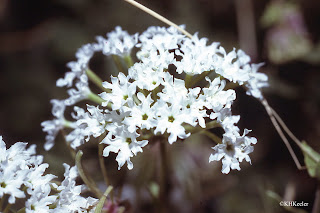
My common name for Abronia fragrans is prairie snowball, but the USDA website prefers snowball sand verbena and the Flora of North America calls it fragrant white sand-verbena. It is a small perennial plant in the family Nyctaginaceae (the family of four o'clocks and bouganvillea), native to the central U.S. plains (Distribution link).
I first encountered it at the University of Nebraska's Cedar Point Biological Station north of Ogallala, NE. We'd play volleyball after dinner beside the dining hall. About the time we were quitting one evening, I smelled a lovely scent. I circled our sandy playing field and found a scruffy little plant with long tubular white flowers. The scent reminded me of lilacs.

My common name for Abronia fragrans is prairie snowball, but the USDA website prefers snowball sand verbena and the Flora of North America calls it fragrant white sand-verbena. It is a small perennial plant in the family Nyctaginaceae (the family of four o'clocks and bouganvillea), native to the central U.S. plains (Distribution link).
I first encountered it at the University of Nebraska's Cedar Point Biological Station north of Ogallala, NE. We'd play volleyball after dinner beside the dining hall. About the time we were quitting one evening, I smelled a lovely scent. I circled our sandy playing field and found a scruffy little plant with long tubular white flowers. The scent reminded me of lilacs.
Subscribe to:
Posts (Atom)