Sunday, July 10, 2022

The Victoria Water-lily I. History

It is one of the wonders of the world. A water-lily with leaves 8' in diameter and beautiful fragrant flowers nearly 12" across. It would have been famous in any event, but it was discovered for England in 1836 in British Guiana by Robert Schomburgk, just as Queen Victoria was about to become Queen of England. Members of the British botanical and geographical communities, individually and collectively, dedicated it to Queen Victoria. So they named it Victoria regia in her honor. (Not without controversy, see Flower of Empire for a detailed story). 

Victoria water-lilies in the Peruvian Amazon
Victoria water-lilies on the upper Amazon in Peru

Today you can see it growing in many botanic gardens or buy seeds if you want to try for yourself. Today it is called Victoria amazonica, with two other species in the genus, the largest described in July 2022. I'll explain all that. But when I saw the plant in Amazonian Peru, I was struck by its botany, not its name or history. So this became a two-part blog, one on the finding and naming of it, and the other on it as a plant (botany). 

Sunday, July 3, 2022

Estes Park, Colorado, June Wildflowers

 Hike with me up a dry mountainside in Estes Park, Colorado. It is late June, almost July. But mountains are fun; climb a few hundred feet or turn a corner and the season is two weeks earlier or later, because it is cooler or warmer, shadier or sunnier, moister or drier there. Elevation and aspect make dramatic differences. (And so does location, going north or south changes your season too.) So you might see these plants in bloom in other months. 

western wallflower, Erysimum capitatum

Sunday, June 26, 2022

Thinking about Insects

We need to revise our attitude toward insects. 

It is probably fair to say we've waged war on insects this last half-century in the United States. Insects were generally bad: mosquitos when you ventured outside, cockroaches and ants in the kitchen, caterpillars and grasshoppers in the garden, moths in the stored woolens, weevils in the jar of beans of walnuts. You get the picture.

bee on echinacea flower
bumble bee on echinacea flower

So we deployed better and better weapons against them, to the point of spraying pesticide around neighborhoods to kill mosquitos. But of course that killed all manner of nontarget insects. (And, very few mosquitos; to reduce mosquitos, drain their breeding puddles.) So today insect numbers are way down. Not just monarch butterflies, but painted lady butterflies, swallowtail butterflies, and many, many more.

Sunday, June 19, 2022

The Attractive Wallflowers, Genus Erysimum


western wallflower, Erysimum capitatum
western or sanddune wallflower, Erysimum capitatum

Spring and early summer is when most members of the cabbage and mustard plant family, Brassicaceae, flower. There are a lot of them--774 species in North America. They share the "cross-like" flower structure: four petals at right angles, and the flowers tend to be yellow or white, so they can be hard to tell apart (hint: use seed pod shape.) But one genus that I quickly learned to distinguish is the wallflower, Erysimum. Wallflowers have a compact shape, large flowers (for a mustard), and orangy flowers that set them apart. 

Sunday, June 12, 2022

How Accurate Was That Really?

How do I know what I read is accurate?

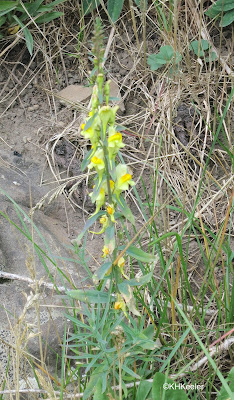
When I write about a plant, I pull books on that topic, books about herbs for example, from my shelf to see what they say about it. I search on the internet for government websites and blogs that discuss it. I usually want to identify the plant, define its names, describe where it originated and where it is found today, mention medical and other historical uses, and find a cool little fact about its biology to include. It becomes clear when reading all those sources that people writing about plants often quote each other. Of course. I didn't pour through old manuscripts to find the medical uses of yellow toadflax; I read people who did, or people who read people who did.  

yellow toadflax
yellow toadflax

And that's what's bothering me today. When are the people who I quote accurate and when am I repeating something doubtful?

Sunday, June 5, 2022

Planting Natives: Beautiful Colorado Flowers

The push to plant natives to make habitat for native animals, particularly birds (see previous post link) touches our often-negative attitudes toward native plants (wild plants). "Really, I should plant that stuff?"

Colorado grassland
A bit of native Colorado grassland in June 
The thistle in front is native, wavy-leaf thistle, the blue flax (Linum lewisii) are hard to spot, the red-orange hawkweed (Hieracium) is from Europe, the yellow is a wallflower (Erysimum), and a diverse collection of hardy grasses.

Our local plants are really beautiful! I'm writing about northern Colorado today, I wrote about central California last week (link). If I had the photos, I could write a "beautiful natives" post for every region in the country.

Sunday, May 29, 2022

California Natives in Pacific Grove Museum of Natural History Garden

The Pacific Grove Natural History Museum has a garden of native plants. In this post I share my photos from a visit in April. It meets two goals: a travel post and an affirmation that planting natives is not a hardship, you can have beautiful plants.

The first is the spectacular California flannel bush, Fremontidendron californicum (hibiscus family, Malvaceae). It is a native, fast-growing shrub (to 30'). The leaves and twigs are covered in a soft fuzz, the flannel. The scientific name honors J. C. Fremont (1813-1890) who explored California in the 1840s and took control of California for the United States in 1846. (See bios link). The plant is also commonly called fremontia, its former scientific name (Fremontidendron = Fremont-tree). 

California flannel bush, Fremontodendron californicum
California flannel bush, Fremontidendron californicum