Monday, October 14, 2013

Touring China --

downtown Beijing
downtown Beijing
In September I took a tour of China with the Denver Art Museum's Asian Art Association, coordiated by Access China Tours. We went from Beijing to Dunhuang in the west through Xian and Chengdu in central China to Lijiang and Dali in the far southwest (Yunnan Province) ending in Shanghai. The contrasts are staggering and I am trying to organize what I saw. We tend to talk about "going to --" as if landing in the capital or the top tourist location will show you all the place has to offer. It is not that easy!

In US terms, our trip was like seeing New York City and Washington D.C., the countryside near Atlanta, Georgia and Biloxi, Mississippi, as well as visiting Taos, New Mexico...different in levels of urbanness, climate, history, ethnic mixes...

Dunhuang, China
Dunhuang dunes
Beijing is "China"...As the capital most tours go there. The traffic was pretty continually snarled and the air gray. That said, the Forbidden City (a quaint old name, in modern Chinese the name is the Former Palace), Tiananmen Square, the art museums and the Great Wall are all well worth seeing. In September, it was warm and relatively humid.

Dunhuang, in Gansu Province, is about 1500 miles (2,438 km ) west of Beijing, on the edge of the Gobi Desert. It was dry! Days were hot and nights very cool. Great sand dunes loomed above the town. An important trading area, the people were and are a mix of races and ethnic groups. A small place with a long interesting history.

Monday, October 7, 2013

Botany Rules: Why Change Scientific Names?! Part 2


Helianthus pauciflorus
stiff sunflower Helianthus rigidus
when the photo
was taken, now Helianthus
pauciflorus
     Plant names of American plants are changing more right now than they have for centuries because of the joint impact of the Flora of North America Project and DNA sequencing. I talked about the Flora of North America project last post.  LINK   

  There would certainly have been changes in American plant names as a result of the writing of the Flora of North America, but the concurrent emergence of DNA sequencing has produced surprising new data to integrate. 

      Compared to animals, plants have a simple structure. Botanists recognize only three tissues: root, stem and leaf. Flowers and fruit are specialized leaves. From descriptions of the arrangement and details of these three tissues botanists created plant classification. They used all the tools they had: complex measurements, chemical analysis, geographic patterns, and ability to hybridize, for example. 
  
     After 400 years of applying these techniques, plant biologists thought they were pretty close to having found the true relationships among plants. They were wrong. DNA data has revealed many surprises. In particular, it has shown convergence, where two plants look very similar but turn out not to be closely related at all. For example, flowering plants living in ponds or streams have similar characters for living in or under water, but their ancestors are found all over the plant kingdom. 

Tuesday, October 1, 2013

Botany Rules: Why Change Plant Scientific Names?! Part 1


Trientalis europea, formerly Trientalis latifolia
Trientalis europea, formerly Trientalis latifolia. Why?
   Two very important things happened to plant names in the botanical world starting in the 1980s:  the flora of North America project and DNA sequencing. I'll talk about the Flora of North America today and DNA sequencing next time.

     For the post on California coastal forests ( LINK) I looked up the plants I saw this May in plant books published in the 1970s. I found the plants but when I checked, almost all the names had been changed. Specifically star flower, in the old books as Trientalis latifolia is now Trientalis europaea, what was called Rubus vitifolius, the Pacific dewberry is now Rubus ursinus and Montia perfoliata, miner’s lettuce is now Claytonia perfoliata, 

   Books and botanists tell people that each plant or animal has only one scientific name so it is surprising and a bit annoying to discover the name you learned is incorrect.   

    Why?

Monday, September 23, 2013

Visiting China: Autumn Greetings, Chrysanthemum and Maple

red chrysanthemums
red chrysanthemums 
     As summer fades into fall, a different set of plants dominate the landscape.  In my garden, the chrysanthemums that were an unassuming cluster of leaves all summer are now covered in blossoms.  My fruit trees are dropping apples and haws. Burning bush (Euonymous) and maples start to turn color. 

   My garden is in Colorado but those are Chinese plants or plants also found in China. In the late 1800s and early 1900s "plant hunters" searched east Asia for garden plants. Many familiar garden plants--lilacs, peonies, ever-blooming roses, nandina, butterfly bush--are native to China, introduced to the West by the plant hunters.
Chrysanthemums along the wall, Suzhou, China
Chrysanthemums along the garden wall, 
Suzhou, China

The Chinese  Chrysanthemum

   Traditional Chinese culture noticed the progress of the seasons and cherished it. Plants were associated with seasons--plum blossoms in spring, orchid in summer, chrysanthemum with fall, bamboo in winter--to name The Four Gentlemen, also known at the Four Plants of Virtue. The right plant for the season was important. Having plants out of season brought bad luck. 

Monday, September 16, 2013

Visiting China: Chinese Landscape Painting and Chinese Landscapes


Huang Shan, Yellow Mountain, China
   Books on art history tell me that landscape painting as a distinctive style first appeared in Europe in the 1500's. The Chinese have a much longer history of painting landscapes. Several landscape paintings from the 11th century survive and literary sources refer to earlier works. Here are links to two 11th century examples: Guo Xi Early Spring (1072) and Fan Kuan (10th-early 11th C), Travelers Among Mountains and Streams (scroll down).

Chinese  shanshui landscape painting
Chinese landscape painting
  The landscape paintings of China look exotic. They are executed in ink with a brush and are often monochromatic.

    More familiar American and European landscapes are done in bright oil paint. (links to American landscape painters, and English landscape painters, Constable, for example).

    The shapes of the rocks, mountains and trees in traditional Chinese landscape painting seem odd to an American eye. Clouds or fog fill parts of the pictures, adding to the dream-like quality.

Monday, September 9, 2013

Plant Story: the amazing drought-tolerant buffalo grass, Buchloë dactyloides

buffalo grass, Buchloë dactyloides
buffalo grass, Buchloë dactyloides
growing in a path
   Last post (link) I talked about how buffalo grass, Buchloë dactyloides (grass family, Poaceae) spread because it was eaten and planted by bison (the American buffalo, Bison bison), and how it provides all-year nutrition for bison (and cattle). One result of this mutually beneficial relationship was that bison spread buffalo grass all over central North America.

    However, just being carried by bison isn't enough to explain the wide natural distribution of buffalo grass. The plants had to to survive in the places bison took them. And they did, very well indeed. Buffalo grass is characteristic of the North American high plains--in fact it is one of the three most abundant grasses. It is highly successful in a region of frequent droughts, long and short, mild and severe.

Monday, September 2, 2013

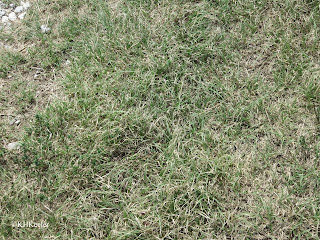
Plant story: the amazing buffalograss, Buchloë dactyloides


buffalo grass, Buchloë dactyloides
stand of buffalo grass, Buchloë dactyloides, 
grass family, Poaceae. Area is about 1 square yard.
  Buffalograss is one of my favorite plants. Grasses get walked over a lot, with people not even trying to tell them apart. One of buffalo grass's strengths might be recognizability. Once you learn what it looks like, it is easily recognized. The leaves are narrow green ribbons. The plant sends out runners which root and let it spread. It never grows more than 8-10" (20 cm) tall. You never have to mow a buffalo grass lawn.
herd of bison
herd of bison (old bad photo)
  For clarity I should state that I'm talking about Buchloë dactyloides, the buffalo grass that is native to the high plains of North America. There is a tall (3', 1 m) grass in southern Africa called foxtail buffalo grass which I have seen labelled "buffalo grass" online. I don't mean that buffalo grass. And, apparently South Africa and Australia call Stenotaphrum secundatum buffalo grass or buffalo lawn grass. In the U.S., the usual name for S. secundatum is St. Augustine grass. I don't mean that buffalo grass either. I mean the North American native buffalo grass Buchloë  dactyloides.
buffalo grass, Buchloë dactyloides
buffalo grass, Buchloë
 dactyloides,
closer view, area less than 1 square
foot. The grass blades are about 4"
tall.

  (I have no idea why there are dots, an umlaut, over the e. There are two syllables there, though: Buk lo ee).


   The "buffalo" in the name of the buffalo grass refers to the American bison, Bison bison, popularly called the buffalo. Buffalo grass, Buchloë dactyloides, apparently owes its distribution to the bison. And it contributed to the bison's success. In sum, they have a mutualistic relationship aiding both, even though they are grass and grazer.