Showing posts with label botany. Show all posts

Sunday, August 11, 2019

Botanists at Work-- Botanical Society meeting 2019

Tucson in July

The Botanical Society of America met in Tucson, Arizona at the end of July. I attended to keep current. Everyone said "Arizona? In July?" but it was lovely (see blog about the desert in July link).

Sunday, August 5, 2018

Botanists at Work--Botany2018 Meeting

This year I again attended the Botanical Society of America annual meeting this year in Rochester, Minnesota. I go to keep up--since I write this blog from retirement, attending professional meetings helps me check that I am providing accurate information.

Rochester Minnesota

So I attended general lectures and technical papers, read posters, looked at the books the publishers brought and, of course, talked to people.


Sunday, April 29, 2018

Visiting Northern Colorado--Early Spring Wildflowers

Devil's Backbone, Loveland, Colorado
Plants seen along the Devil's Backbone Trail, Loveland, Colorado
This year, spring in northern Colorado has been punctuated with cold snaps and snow storms, which have delayed the appearance of spring wildflowers.

Well, that is one way to say it. Another is that the cool temperatures extended the visibility of the early flowers.

Sunday, April 22, 2018

Cosmopolitan Weeds--Friends of the Botanical Traveler

Victoria, Australia
Victoria, Australia
Thousands of miles from home, surrounded by plants strange to me, I am delighted to see a plant I know.  Look, a dandelion!

dandelion, Taraxacum officiale
They probably are weeds to the people who live in Australia, just as they are in Colorado, but surrounded by unknown plants, the dandelion looked like an old friend.

Sunday, April 8, 2018

Plant Story--Lovely Lilacs

lilac flowers

Lilac bushes grew in the yards of the houses in which I grew up and I assumed Americans had always had lilacs. After all, Under the Lilacs written in late 19th century New England, was one of Louisa May Alcott’s classical children’s stories. But lilacs are from Eurasia, and the classical lilac-colored lilacs, Syringa vulgaris, are native to eastern Europe. 

The word lilac is derived from a word for blue, though the experts don’t agree quite which language started it. You can read that it comes from Persian and Spanish but those are far from the native range of lilacs so likely not the source. Geographically, lilac is likely from a Balkan language, Albanian for example, but I have found no clear linguistic argument. Since lilac is a color word in English, it has come full circle: the plant was called lilac describing the flower colors and then in other languages, the name of the plant, lilac, became the name of a color

Sunday, December 31, 2017

Happy New Year! -- Plant Jokes Again

Happy New Year!

I had great fun publishing plant jokes last in the New Year post last year, so here are some more: 

1) Why couldn't the gardener grow any flowers?

pines and junipers in yard

He hadn't botany.


Sunday, October 19, 2014

Plant story: The amazing dioecious buffalo grass, Buchloë dactyloides

buffalo grass, male flowers
buffalo grass, male flowers, sticking up 

Buffalo grass, Buchloë dactyloides' (or Bouteloua dactyloides) [previous posts on buffalo grass and bison; drought tolerance, name] is a short drought-tolerant native American grass. It was one of the dominant (most common) grasses of the American high plains with a broad range from Mexico to Canada across our driest grasslands. It is highly regarded as food for cattle and bison. It is now being widely planted as a water-efficient lawn grass.

The success of buffalo grass is the more amazing to me because buffalo grass is dioecious. Dioecious means that there are male plants and female plants that have to mate before a seed is produced.

Sunday, July 27, 2014

Visiting the Faroes--Grass-covered Hills and Marsh Marigolds in the Sheep Islands

Faroe Island view
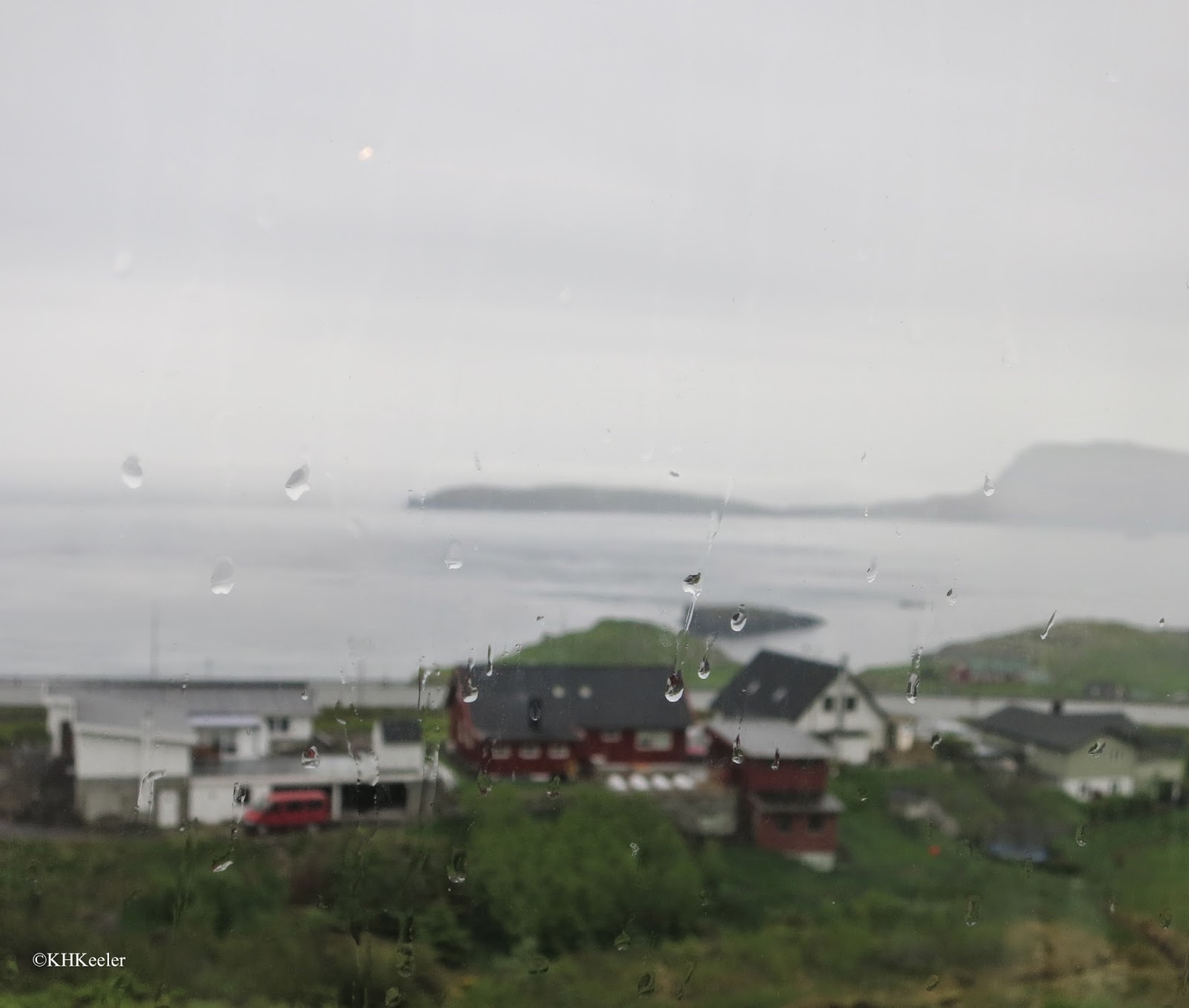
Faroe Island rainy morning, through the bus window
The Faroe Islands are in the North Atlantic, between Norway and Iceland. (See map. ) I visited them about the first of June on a tour with the Metropolitan Museum of Art, organized by Academic Arrangements Abroad. There are 18 islands, 17 with at least one inhabitant. 

It was cool and raining when we arrived. On the same latitude as the middle of Hudson Bay, the Atlantic's Gulf Stream keeps the temperatures mild. Average highs are about 51 ( 11 C) in summer and 37 (3 C) in winter. It rains more than 16 days a month all year round, though the rain may be a passing shower or a day of drizzle. Total annual rainfall varies between islands but in the capital, Tórshavn, it is about 50" (1280 cm).

Sunday, July 13, 2014

Wandering Plants -- Coconuts of Medieval Iceland!

coconut palm on beach, Pacific coast, Panama
coconut palm on beach, 
Pacific coast, Panama
A coconut in Iceland? in the Middle Ages?

I'm sure I could find one in the market in Reykjavik today. Coconuts are tropical but lots of tropical things are traded all over the world. For example, Icelandic chocolate is a favorite across all Scandinavia.

However, looking back into history, travel was slow and often difficult. Coconuts are native far, far from Iceland. 

Coconuts are the seeds of the coconut palm, Cocos nucifera (palm family, Arecaceae). Palms, like bananas and bamboo, are not strictly trees, because they do not form wood. The tough and flexible coconut palm trunk is made of the very tightly overlapping bases of the large leaves. Coconut palms can grow 80’ (24 m) high. 

Sunday, July 6, 2014

Plant Story -- Colorful Columbines, Aquilegia

Rocky Mountain columbines,  Aquilegia coerulea
Rocky Mountain columbines,
Aquilegia coerulea
Everybody knows columbine, right?

Columbines, Aquilegia species, are distinctive plants related to anemones and buttercups (in the buttercup family, Ranunculaceae). 

Actually, where you live makes a big difference to what you think a columbine looks like. In eastern North America, there is only one native columbine, Aquilegia canadensis. It has red sepals and spurs on the outside with yellow petals, stigmas and stamens inside. Click on the LINK !

The situation in Europe is similar. There is one common columbine, Aquilegia vulgaris. It has blue to purple sepals with white petals, stigma and stamens. Click on the LINK ! There are almost 20 rare columbine species in the mountains of Europe, but A. vulgaris is far the most widespread. In Latin, “vulgaris” means common, so the common European columbine is aptly named.

If you live in either of those areas, you are likely to have a particular image of columbine in your mind. 

Sunday, May 18, 2014

Plant story--Primroses, Primula--Post Script

Every subject I write about has far more information available than will reasonably fit into even two posts. (previous primrose posts 1, 2). Usually I keep it to two posts and save the rest for "someday." However, I can't resist sharing what I learned about the word thrum and the color primrose. 

First: what is a thrum?

The only place I'd ever heard the word thrum was in a graduate school botany class , for the flower form of primroses (link)--until I started weaving ten years ago. Thrums are the short ends that are cut off when a piece of weaving comes off the loom. From Dictionary.com: 1. one of the ends of the warp in a loom, left unwoven and remaining attached to the loom when the web is cut off." 


brown thrums hanging on the loom

Sunday, May 11, 2014

Plant Story - More Reasons to Like Primroses, Primula


primrose, Primula
primrose, Primula
Primroses, genus Primula, are well-known European spring garden flowers. And wildflowers, since the common English name cowslips is probably from cowslops, --the common primrose, Primula veris, grew (and grows) well in English cow pastures. The English liked them as a sign of spring. (Link to previous post).

Which is probably why Charles Darwin and botanists before and after him, took a close look at the flower and discovered that there were two kinds of flower. Not two species, but two different flowers within a primrose species.

Monday, January 20, 2014

Visiting Northern California--Secret Garden Cottage, Inverness

View of Tomales Bay out the window
The word garden lured us to stay at a bed and breakfast in Inverness, California. The Inverness Secret Garden Cottage is on a hill above Tamales Bay, just inland of Point Reyes National Seashore.

Remembering it most of a year later, I am jealous. The climate of the Northern California coast is moist and mild. The garden includes wonderful plants I cannot grow.

What would those be? Oh, coast redwood, jasmine, big rhododendrons, camellias, to name a few.

Monday, January 6, 2014

Visiting Costa Rica—A Rainforest Walk

looking back at the beach, Costa Rica
My Betchart/Lindblad expedition last month took me to Costa Rica (see earlier post). We sailed north along the Pacific Coast, stopping at Corcovado and Manuel Antonio National Parks, before disembarking to fly home from San Jose.

I first visited to Costa Rica in 1972, with the Tropical Ecology course of the Organization for Tropical Studies, did Ph.D. research there, and have been back several times since. 

Costa Rica is about the size of West Virginia. Within that small space it is very diverse. The mountains down the center create a whole series of different ecosystems, varying in temperature and rainfall and more. There is tropical rainforest on both the Atlantic and Pacific coasts, but, cut off from each other by the mountains, they have different plants and animals. On the Pacific side in the northern half of the country, severe drought from December to June combined with heavy rain the rest of the year has created a distinctive tropical dry forest. 

In Costa Rica's southwest corner, I had a terrific time hiking in the lowland rainforest at Corcovado National Park.  
Pacific lowland rainforest, Costa Rica

Monday, December 30, 2013

Curious Plant Story--Cabbage Walking Canes

Walking sticks from cabbage!  What you see in the video is a stick made from Brussels sprouts.  This post is about that project and the reason for it.

I’m making a short video about the fact that the vegetables cabbage, broccoli, Brussels sprouts, cauliflower and kale are all botanically the same, Brassica oleracea (cabbage family, Brassicaceae). The oddest fact I plan to include is that in the 18th and 19th centuries, on the islands of Jersey and Guernsey in the English channel, the cabbages grew to 20' tall and their stalks were dried, varnished and used as walking sticks. LINK

People on the Channel Islands raised cattle as well as cabbages and broke off the big lower leaves to feed their cows. In the cool, moist climate--perfect for cabbage plants--the plants grew taller and taller, while people picked off more lower leaves. Since the growing season is long and the frosts light, the cabbage plants sometimes reached twenty feet tall, with big cabbage leaves at the top. They looked from a distance like palm trees. 

The stems were pretty tough, so when the plant died, the resourceful islanders found a variety of uses for them. One was to dry, smooth, and varnish the cabbage stems and use them for canes or walking sticks.  

Time and change has mostly eliminated both the giant cabbages and the walking stick industry, but they still make a few (Note: 2/1/21: having gained attention, Jersey residents are making more walking sticks. link)
Brussels sprouts
Brussels sprouts

I wanted to show a picture of the canes in the video but I wasn't sure about copyright issues on the pictures I found.

Monday, December 23, 2013

Visiting Panama--Botanical Impressions

Ixora
Ixora
I recently took a week’s trip through the Panama Canal and up the Pacific Coast to Costa Rica. 

It was lovely. Traveling in a ship means I unpacked only once. It also meant I could retreat to air conditioning. 


This was an expedition/cruise on the National Geographic Sea Lion. Betchart Expeditions and Academic Arrangements Abroad working for the American Association for the Advancement of Science and Sigma Xi organized my part, but others on the ship had signed up with National Geographic Expeditions and Lindblad. Lindblad organized the actual itinerary and provided the staff. This kind of complexity is common on tours for many reasons, including keeping group size small while filling a 70-passenger ship.

really big tree, Panama
lovely big tree, Panama

I had never been to Panama. It is tropical, about 10o N of the Equator. We were never very far above sea level. That made it the quintessential tropics: warm and humid! The temperature range, day and night, all year, is between 68 ad 93oF. The rainfall in Panama City is 75” annually, but many areas are much wetter. With warm temperatures and plentiful rain, the plants were lush. 

Monday, December 16, 2013

Travel Story: In Pursuit of the Bush Morning Glory

Ipomoea leptophylla
bush morning glory Ipomoea leptophylla
One reason I became a plant ecologist was that my ecology class professor at University of Michigan, Dr. William Benninghoff, left, as planned, in mid-semester. He did research in the arctic and seasons in the tundra don’t wait for anyone. Ah, I observed, ecologists travel!

I had a chance to experience that again this summer.

From Indiana University came Ph. D. student Wesley Beaulieu and Professor Keith Clay to collect morning glory seeds. Not just any morning glory but the bush morning glory Ipomoea leptophylla. Since I had studied the bush morning glory, I agreed to be the local guide.

Monday, December 9, 2013

Dye Plants: Yellows from Many Sources

naturally-dyed yarns
Naturally-dyed yarns
I love color. I have knitted and woven and embroidered since I was very small. Trying plant-based dyes was an obvious intersection of my interests. Plants! Color! Wonderful! 

So off and on I will write about dye plants, even though most of the important dye plants are unknown to most people.

But dyes from plant sources are familiar. The grass stain you got on you jeans sliding into first in the neighborhood softball game? That's a basic dye found in most leaves. Leaves of many plants will produce a yellow or olive green dye. 

Monday, December 2, 2013

Plant Story: Rocky Mountain Bee Plant (Cleome serrulata)

Rocky Mountain bee plant, Cleome serrulata
Bees like it too.
I wrote a few weeks ago that it would be nicer if the pretty flowers on the roadside were native plants, not escaped aliens (link). One plant that fills that role in my region is Rocky Mountain bee plant, Cleome serrulata.

Rocky Mountain bee plant is a native North American relative of the cleome that is widely sold as a garden flower, commonly called spider flower (link to photo). Spider flower is Cleome hassleriana from South America. Rocky Mountain bee plant is smaller than spider flower and, as far as I know, only has purple flowers, not white,cream or pink.