Monday, June 24, 2013

Unrelated Plants: The Strange Case of Nasturtium and Watercress


watercress, Nasturtium officinale
nasturtium, Trapaeolum majus
nasturtium, Tropaeolum majus


     If you have ever looked for nasturtium in the index of plant book, you will have wondered why nasturtium is the scientific name of watercress and the common name of Tropaeolum

    Watercress is a Eurasian plant in the mustard family, Brassicaceae, that has been eaten as a vegetable for centuries. The leaves have a sharp taste. The flowers are white but relatively small and not very conspicuous. It was definitely known to the Romans. Linnaeus named it Nasturtium officinale. It has been called Rorippa nasturtium but current opinion is that it is different enough from the rorippas to be kept separate. Nasturtium nasturtium-aquaticum is another name you will also see for watercress, but Nasturtium officinale has precedence and so is the correct name.

    Nasturtium is a yellow or orange flowered plant, genus Tropaeolum majus (plant family Tropaeolaceae). Nasturtiums are native to the west coast of South America . “[I]t is used as a food in Peru today, as it has been for thousands of years” (Kipple & Ornelas p. 1821).  Tropaeolum was introduced to Europe from the New World in the late 16th century. In the early herbals, for example Gerard, it is called Indian cress.

    Nasturtium is not a common word. It seems odd that nasturtium is Tropaeolum and Nasturtium officinale is watercress. 

Monday, June 17, 2013

Plant Story: small soapweed, Yucca glauca

Yucca glauca in flower
     Standing like candles in the prairie, flowering soapweed yuccas make a handsome display.

A young Yucca glauca
A young Yucca glauca.
You could cover all but the
outer tips of the leaves by
setting down a pop can. 
     Soapweed yucca, Yucca glauca  (asparagus family, Asparagaceae) is found from Canada to Mexico across the central U.S., in areas that before settlement were grasslands.

   Like other yuccas, Y. glauca has a rosette of leaves and can live many years. The plants start as tiny rosettes of short thin leaves and as the plant gets older, the leaves get more numerous and longer.

  The leaves are tough and fibrous, with a sharp point at the tip. Cattle generally avoid eating the leaves. Biologists generally avoid walking where the leaves will stab their legs. The evening volleyball game at Cedar Point Biological Station featured the phrase "stucka by a yucca" for players who ran heedlessly after a stray ball into the plants surrounding the improvised volleyball court.

Monday, June 10, 2013

Plant Story: Common Houseleek, Sempervivum tectorum, Folklore

Sempervivum tectorum, hens-and-chickens
Sempervivum tectorum, hens-and-chickens, aka Jupiter's  beard
stonecrop family, Crassulaceae
   One widely-planted succulent (see previous post) is the plant I grew up calling hens-and-chickens Sempervivum tectorum (Crassulaceae, stonecrop family). These days the preferred common name seems to be houseleek. There are 34 genera and 1,400 species in the Crassulaceae, with 30 species of Sempervivum and hundreds of Sempervivum hybrids and cultivated varieties. Sempervivum tectorum thus gets called the common houseleek, since you might want to call all the other sempervivums houseleeks too. 

   Native to Europe, the common houseleek has been grown in and around human settlements for millennia. Like many plants that are familiar to a lot of people, it has many common names. Frequently used in the U.S. are hens-and-chickens and common houseleek. More obscure common names are Aaron's rod, bullocks eye, Jupiter's beard, Thor's beard, syngreen, and a half dozen more (see Wikipedia entry).

Sempervivum tectorum rosette -  note thickness of leaf
Sempervivum tectorum rosette -
note thickness of leaf I broke
   The scientific name, Sempervivum, means "live forever" (semper = always, vivum = living), as does the common name syngreen and its variants. This doubtless refers to the fact that uprooted plants can survive for weeks, living on their stored water. Pluck up a pansy (Viola tricolor) or a dandelion (Taraxacum officinale), with or without roots, and in hours they are wilted and in a day or two, dead. Do the same thing to a rosette of hens-and-chickens, and more than a week later you can stick it back in  moist soil and it will recover. Try it!
This is the benefit of storing water the way a succulent does.

   The hens-and-chickens common name follows from the growth form, where little clones are grow around the initial plant. (See picture below, but I don't have a really classic photo of hen with chickens.)

hens-and-chickens in rock garden in Colorado
hens-and-chickens in
rock garden in Colorado
    The tectorum in Sempervivum tectorum and the English names Jupiter's beard, Thor's beard and houseleek all refer to the plant's long association with lightning.

     This is a story that seems very odd to us in the modern world.

Monday, June 3, 2013

Visiting Northern California: A Garden of Succulents


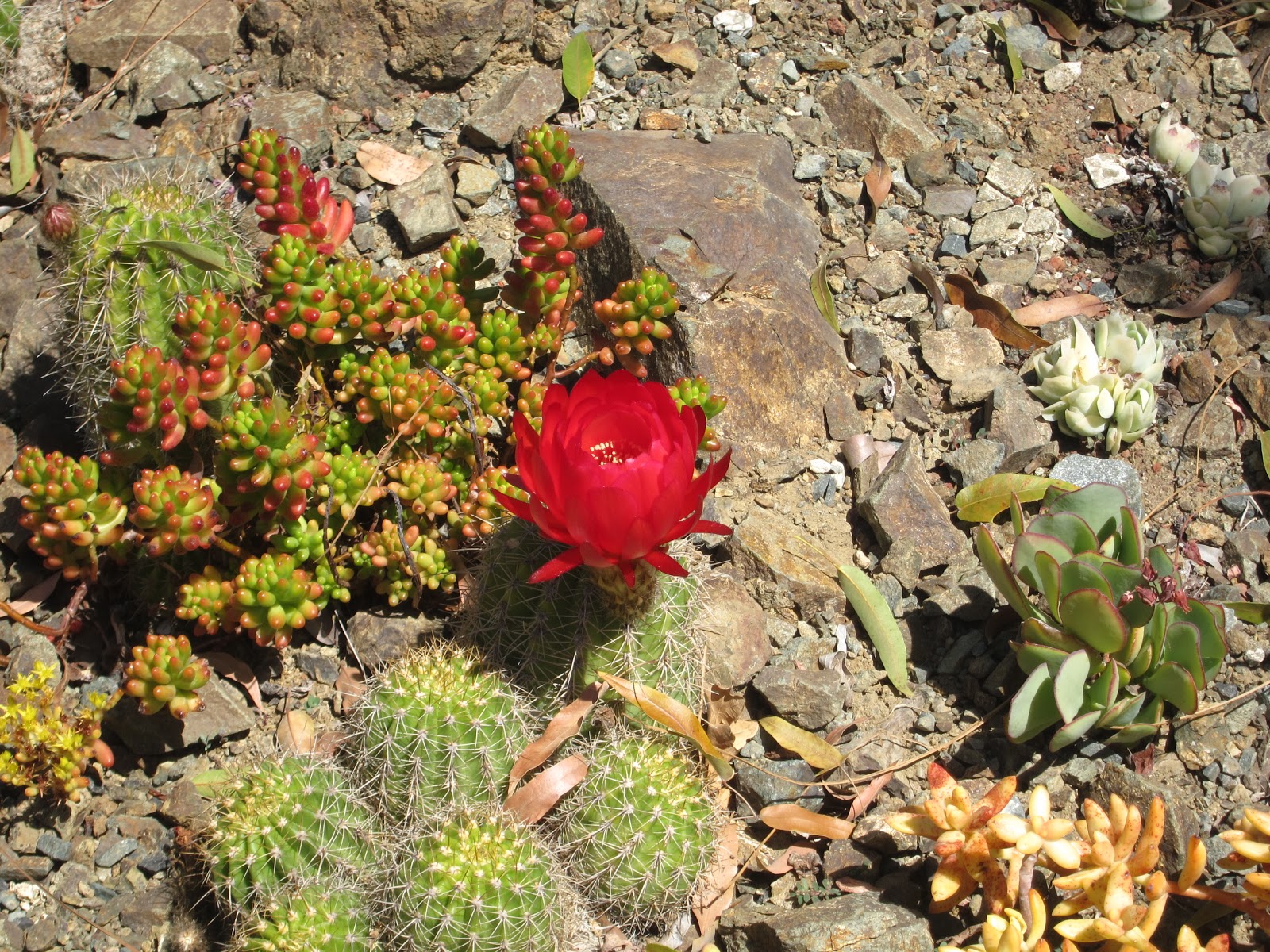
cactus in bloom, and a variety of other succulents
Cactus in bloom, and a variety of other succulents,
Ruth Bancroft Garden, Walnut Creek, CA
small succulent, flowering
   Succulents are plants with fat fleshy leaves or stems in which they store water. All over the world, different plants have become succulent, so there is no particular relationship between succulents, although some groups, for example the cacti, are particularly rich in succulents.

     The Ruth Bancroft Garden in Walnut Creek, California showcases the diversity of succulents. 

   For hundreds of years, people have enjoyed growing succulents.  Most succulents are from dry areas around the world and evolved to tolerate dry conditions. Most deserts around the earth occur at 30o North and South, so the winters are mild. A few succulents can survive really cold conditions, but those are exceptional. That means in northern Colorado where I live, the array of succulents I can find is limited, and in the East Bay of northern California, where I visited, a much greater variety of succulents can be grown.

   In general, succulents are easy to grow, requiring very little care if planted in favorable locations. And mostly their idea of a favorable location is some rocky spot in full sunlight, which is often a place where other plants grow poorly.

Monday, May 27, 2013

Visiting Northern California: Flowering Agaves!


Variegated Agave americana , Ruth Bancroft Garden, Walnut Creek, California
Variegated Agave americana sending up flowering stalk,
Ruth Bancroft Garden, Walnut Creek,
California
   Agaves (asparagus family, Asparagaceae) are a fascinating group of plants. Many have a life cycle in which they grow as a cluster of leaves (rosette) for years, then send up one huge flowering stalk. The tall stalk produces lots of flowers and seeds, using all the energy stored by the plant over the years. When the seeds are ripe, the exhausted plant dies.

   An hour east of San Francisco in the Ruth Bancroft Garden in Walnut Creek, big agaves were flowering in mid-May, 2013. Wow!

blooming agaves
blooming agaves
  Agaves, for example Agave americana, are called the century plants. However, as staff member Carol Babst pointed out, the century plant name is a misnomer, since agaves rarely live more than 25 years.

   You might not know how old your apple tree or lilac bush was when it died, but since the agaves flower so dramatically and die, people pay attention to their age.

    The flowering stalk is spectacular--10 or more feet high. But equally impressive is that after waiting 15 or 25 years--a long time to wait to flower!--the plants dies. One time to flower only.

    It seemed to me that a lot of agaves were blooming at Ruth Bancroft Garden and Carol agreed, saying that an impressive 26 individuals were in bloom.

Monday, May 20, 2013

Plant Photo Album: Plants High Above Honolulu

Hills above Honolulu
Hiking the hills above Honolulu
    Plants from around the world have been introduced into Hawaii, hundreds of them.  Visitors, walking through touristy areas, see big, colorful tropical plants, but very few of those plants are native Hawaiian species.
 
View from trail, above Honolulu
View from Trail
   However, all the Hawaiian islands are surprisingly rugged, with remote areas that are hard to reach.  AND there are hidden pockets of natural vegetation close by.

Monday, May 13, 2013

Plants of the World: Every Plant is Native Somewhere

California poppy in California grasslands
California poppy
in California grasslands
Tortuguero National Park, Costa Rica
Tortuguero National Park
Costa Rica
      Every plant is native somewhere! That is a truth that eventually strikes the traveler. For me, it was seeing plants I knew as houseplants  growing up a tree in the rainforest of Costa Rica.  
    Whether the plant is grown as a house plant or raised for its fruit or planted as a shrub to brighten the yard, it has a home range somewhere where it can be found growing naturally. 

     (There are a few domesticated plants whose the wild relative has gone extinct, but those are exceptional cases and today I want to talk about the vast majority of the world's 330,000 species of plants.) 

     Where plants are native they don't need human help to grow and reproduce. There, they can be found growing in odd locations--along a fence, on an eroding slope--because they got there by themselves. 

    Do you know the homelands of the plants around you?