Sunday, April 17, 2022

Yard Plants in Monterey, California

I was in Monterey, California this week. I walked residential streets oogling the plants. Exotic plants with huge cascades of flowers, from places like Australia and South Africa. In full flower in April. And then I realized what I wasn't seeing: grass lawns.

Pride of Madeira, Echium candicans

Sunday, April 10, 2022

Native Plants for Wildlife: How to Know a Plant is Native?

As I wrote two weeks ago (link), I'm trying to support birds by growing plants that produce insects for them to eat. The evidence is strong that native plants will support the insects that live around us and that most exotic plants will not. 

BUT, to feature native plants in my yard, I have to know what plants are native. Or, alternatively,  know which of the plants in my yard are not native. That is suprisingly hard. 

garden flowers

Sunday, April 3, 2022

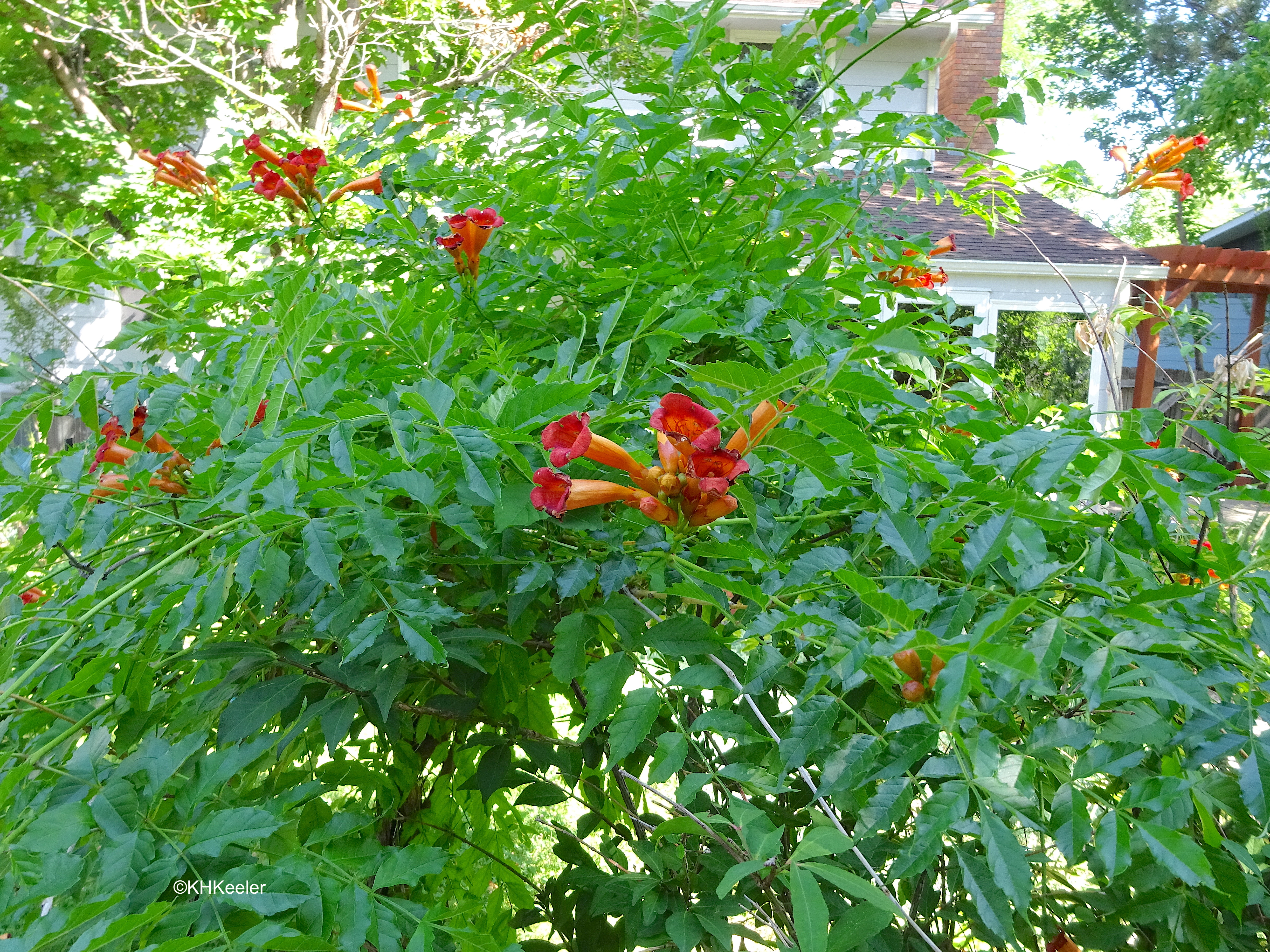
Plant Story:Trumpet Creeper, Campsis radicans

Trumpet creeper, also called trumpet vine, Campsis radicans (catalpa family, Bignoniaceae) has for years been one of my favorite plants. The flowers are spectacularl: large red tubes, classical hummingbird-pollinated shape. The tropics has many plants like this, but in New York and Ohio, trumpet vine stood out. In those areas, it was easy to recognize. Add to the red flowers, long leaves with five or more paired leaflets and one more leaflet at the tip and a woody base, and you see how I knew it when I saw it. And it had an easy common name, trumpet creeper, obvious and descriptive. 

trumpet creeper, Campsis radicans

This big plant is native to the southeastern United States where it is a magnet for ruby-throated hummingbirds, but also for long-tongued native bees and moths. It attracts other flower visitors, like smaller bees, and perhaps they sometimes pollinate. For bees getting nectar is a project since they have to climb into each flower, not just hover in front of it like a hummingbird. The nectar is so good that both the Northern Oriole and Orchard Oriole feed from the flowers. 

Sunday, March 27, 2022

Becoming Part of Homegrown National Park

I've always liked native plants--stately cottonwoods (Populus deltoides), dramatic redbuds (Cercis canadensis), robin-attracting serviceberry (Amelanchier alnifolia), blanketflowers (Gaillardia species), columbines (Aquilegia species)...I can go on and on. I grow them in my yard (well, not the cottonwood, too big) because I like them. But I also have a bit of Kentucky bluegrass lawn (Poa pretense, from Eurasia), creeping buttercup as a ground cover (Ranunculus repens, from Europe), a maple (Acer, not local to area), lilacs (Syringa vulgaris, from Eurasia), iris (Iris, from all over the world), peonies (Paeonia from China), crocus (Crocus from Eurasia) and many others. I like them too.
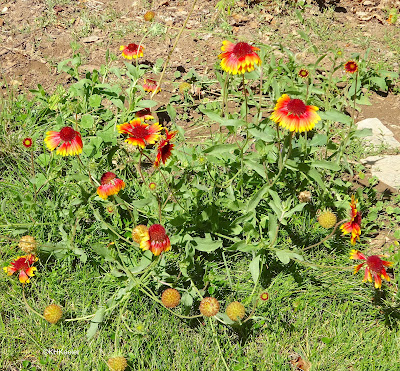
blanket flower, Gaillardia
blanket flower, Gaillardia, native

What I learned recently is that native animals--butterflies and moths, but also wood-borers and leafhoppers--often cannot eat introduced plants. That makes sense to me. In fact, I used to teach that one of the reasons for species being invasive is that they left behind the animals, fungi, and bacteria that ate them, and, with very little damage in the new continent, could grow much better. I never thought about the reverse of that: the impact of nonnatives on the native food chain.

Sunday, March 20, 2022

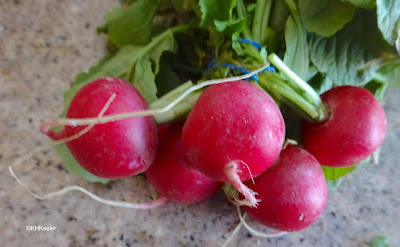
Plant Story--Little Red Radishes, Raphanus sativus

The radish is an ancient vegetable that has been mainly reduced to a garnish. 

radishes, Raphanus sativus

Calling the radish just a condiment is a little excessive, since in Asia radishes are important foods, but in my life, mostly little radishes are sliced into a salad for a little color. Yet they have been grown by Europeans for 5,000 years, and in Asia for at least 2,000. They were an important vegetable in Egypt 4,000 years ago. Greeks and Romans ate radishes, cooked and raw. The Romans spread them all over Europe But we don't seriously consider eating a dish of radishes...

Sunday, March 13, 2022

It is Spring, Some Places

Spring is late on the Front Range of Colorado this year. It is almost mid-March and my yard is under snow. Again. Normally I would have snowdrops and crocuses by now. So a visit to Corvallis and Eugene Oregon was a shocking, wonderful leap forward into spring. I'm posting spring flower pictures for your enjoyment if you are already in spring, for your encouragement if you are not.

hellebore; Helleborus sp.
a big stand of hellebores (lenten rose, Helleborus)

Sunday, March 6, 2022

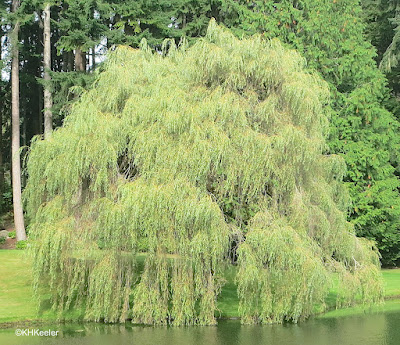
Plant Story--Weeping Willow, Salix babylonica

I was four years old when my parents rented an old house in Scotia, New York. That was the 1950s; my father shoveled coal into the furnace each morning for heat. The back yard was dominated by a weeping willow tree. I think that was the first tree I learned. The tree was huge. Or, I remember it as huge. I was pretty small during the three years we lived there. The fact that I couldn't reach more than a quarter of the way around the trunk should be modified by remembering how short my reach was, at the beginning of elementary school. But my memory that the tree was taller than the two-story house is surely accurate. A big tree with dangling branches, creating a lot of fallen twigs that my father disliked. But the sticks were great for my games!

weeping willow, Salix babylonica