Showing posts with label native plants. Show all posts

Sunday, October 25, 2026

Thoughts on Native Plants

"What's native to my area?" Gardeners are asking that a lot these days.

It says a lot about how thoroughly we have changed the landscape that many people have almost no experience with the plants that are native where they live.

backyard
historical back yard, no natives

Monday, April 6, 2026

Native Plants Are, Well, Wild

When you plant a native plant, you might find it spreads aggressively around the yard, crowding out  other plants in the garden. That isn't necessarily a bad thing, but if you are growing natives, you need to be aware that some are pretty wild. 

black-eyed susan, Rudbeckia hirta
along a path; not where I planted the first one

Sunday, August 31, 2025

Gardening is Changing

Gardens and yards are changing. People are reducing their use of herbicides and pesticides. Planting more water-wise plants. Adding natives. Appreciating mixes of plants not just monocultures, whether in the lawn or the flowerbeds. All of this is revising our ideas of what an attractive yard is. 

front yard with natives
front yard, natives (and others), no lawn grass

Sunday, November 26, 2023

Native Plants. Part 4. Cultivars

Increasingly you see advocates for planting natives adding "do not buy cultivars." 


Cultivar is defined as "a plant variety that has been produced in cultivation by selective breeding." In the context of native plants, we are talking about wild native plants that have been grown and selected for desirable characteristics, perhaps a more intensely pink flower or resistance to mildew. 


red osier dogwood with variegated leaves
dogwood cultivar with variegated leaves

Breeding changes plants. Of course. A cultivar is not genetically the same as its wild relatives. Offspring are not the same as their parents. The key for using or not using cultivars is whether the changes in the cultivar cause insects that eat leaves or gather pollen and nectar from the wild variety to avoid the cultivar. 

Sunday, October 22, 2023

Grow Native Plants. Part 1: Why?

The conservation community is urging people to grow plants native to their area. At the same time, you can find articles arguing against planting cultivars of native species. It is difficult, buying a native plant, to figure out how to avoid a cultivar. And why should you? This is a big topic. I'll cover it in a series of posts. First, why grow natives at all?


beebalm, Monarda and blackeyed Susans Rudbeckia
Natives beebalm, black-eyed susans and a bit of grass

Sunday, March 12, 2023

Gardens and Natives: Colorado is Distinct from the East

I attended Landscaping with Colorado Native Plants conference in February. I came away very conscious of all the differences in gardening between our region and other places, especially the eastern U.S. If you want to grow Colorado natives, they recommended planting in a thick layer of crushed gravel (stone!), adding no fertilizer, washing off the potting soil to plant plants bare-rooted, and within a year, reducing water to once per week or once per month or not at all (that is, depending on rain and snow for water).  

natural vegetation, Colorado grassland
 natural vegetation, Colorado grasslands

We imported our idea of landscape and garden mainly from settlers who came from Kansas or Iowa or Kentucky or Pennsylvania.

Sunday, June 26, 2022

Thinking about Insects

We need to revise our attitude toward insects. 

It is probably fair to say we've waged war on insects this last half-century in the United States. Insects were generally bad: mosquitos when you ventured outside, cockroaches and ants in the kitchen, caterpillars and grasshoppers in the garden, moths in the stored woolens, weevils in the jar of beans of walnuts. You get the picture.

bee on echinacea flower
bumble bee on echinacea flower

So we deployed better and better weapons against them, to the point of spraying pesticide around neighborhoods to kill mosquitos. But of course that killed all manner of nontarget insects. (And, very few mosquitos; to reduce mosquitos, drain their breeding puddles.) So today insect numbers are way down. Not just monarch butterflies, but painted lady butterflies, swallowtail butterflies, and many, many more.

Sunday, May 8, 2022

The Less Aggressive Iceplant, Sea-Fig, Carprobrotus chilensis, in California

I wrote last week about highway iceplant, Carprobrotus edulis (link). In 1970 as a new graduate student at the University of California, Berkeley, I chose to write a paper about it. I had an Anthropology-Zoology major and writing a paper about a plant for Botany Department professor Herbert Baker was well out of my comfort zone. It is true, as I indicated last week, that I seized on iceplant as conspicuous, but there was more to it. During breaks, my roommates and I explored California, especially the coastline. I saw icesplant hanging off the cliffs at the edge of the Pacific and enjoyed incorporating my observatioins and photos into my assignment. Botanists go interesting places, for work.

Carpobrotus chilensis
Iceplant, Carpobrotus chilensis, California coast 1970
There's a pink flower in the center, 1/5 of the way down

Sunday, April 10, 2022

Native Plants for Wildlife: How to Know a Plant is Native?

As I wrote two weeks ago (link), I'm trying to support birds by growing plants that produce insects for them to eat. The evidence is strong that native plants will support the insects that live around us and that most exotic plants will not. 

BUT, to feature native plants in my yard, I have to know what plants are native. Or, alternatively,  know which of the plants in my yard are not native. That is suprisingly hard. 

garden flowers

Sunday, March 27, 2022

Becoming Part of Homegrown National Park

I've always liked native plants--stately cottonwoods (Populus deltoides), dramatic redbuds (Cercis canadensis), robin-attracting serviceberry (Amelanchier alnifolia), blanketflowers (Gaillardia species), columbines (Aquilegia species)...I can go on and on. I grow them in my yard (well, not the cottonwood, too big) because I like them. But I also have a bit of Kentucky bluegrass lawn (Poa pretense, from Eurasia), creeping buttercup as a ground cover (Ranunculus repens, from Europe), a maple (Acer, not local to area), lilacs (Syringa vulgaris, from Eurasia), iris (Iris, from all over the world), peonies (Paeonia from China), crocus (Crocus from Eurasia) and many others. I like them too.
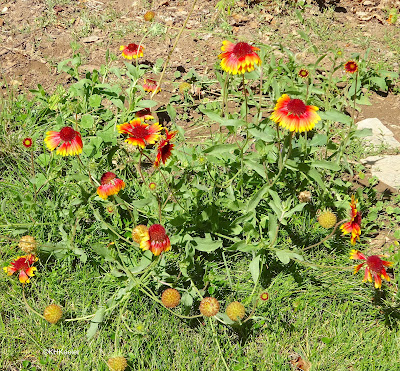
blanket flower, Gaillardia
blanket flower, Gaillardia, native

What I learned recently is that native animals--butterflies and moths, but also wood-borers and leafhoppers--often cannot eat introduced plants. That makes sense to me. In fact, I used to teach that one of the reasons for species being invasive is that they left behind the animals, fungi, and bacteria that ate them, and, with very little damage in the new continent, could grow much better. I never thought about the reverse of that: the impact of nonnatives on the native food chain.

Sunday, December 19, 2021

Our Built Environment

We see the world around us, but we can't see what it was. Visiting San Francisco in November, the National Park Presidio was full of informational signs about the history of the site, pointing to multiple transformations since Spain established a fort there in 1776. (Native Americans left their mark too, as mounds of discarded sea shells, which have been dated back to 740 CE).

Some changes were dramatic. This is the creek as I saw it, the drainage full of shrubs (Thompson Reach).

View crossing bridge
Stream zone that was covered, then restored

Sunday, January 5, 2020

Looking at 2020

Happy New Year! 2020.

snow scene

I decided to make 2020 "the Year of 2020 Vision," reviewing my activities and all my stuff, asking if each is an active interest or something I think I might, maybe, do or use, sometime in the future. My possessions and surroundings should reflect my current self. The trick will be honest answers.

When I dial up 2020 Vision beyond the junk drawer, looking at my yard I find lots of ideas that I have carried over for years, to dust off and reconsider.

Sunday, September 22, 2019

Plant Story--Big bluestem, Andropogon gerardii, Very Successful

big bluestem, Andropogon gerardii in a prairie preserve
Big bluestem in a Kansas tallgrass prairie
Big bluestem, Andropogon gerardii (grass family Poaceae), was once the most common plant across the whole center of the United States because it was the dominant grass of the tallgrass prairie. Alas, that same region grows wonderful corn, so the tallgrass prairie is 99% gone, and big bluestem is no longer very common.

It remains an important forage grass. The new shoots are very nutritious and very attractive to cattle. Where cattle have enough space, big bluestem does well. If the pasture is small, they preferentially graze it until none is left. Range mangers try to maintain big bluestem or reseed with it.

Sunday, April 7, 2019

The Familiar, the Introduced and the Native

lilacs, Syringia
Lilacs always remind me of my childhood in New York and Ohio,
but they are not native to North America
Each of us spends only a few years as a child and wherever we happened to be often is learned as "home." Lilacs (Syringa vulgaris) were on the property where I grew up. I had no idea they came from Asia in the 1800s.

Rarely do we consider what "home" was like fifty years or two hundred years before we grew up there.

And yet, for North America, likely you wouldn't recognize home if you went back very far in time.

Sunday, December 16, 2018

Homogenized World--Attractive and Useful Tropical Plants

I wrote recently that the wonderful trees of any particular location in the modern tropics were drawn from all over the world, many of them in the 16th century as Europeans explored and colonized.

The same applies to smaller plants

Pineapples (Ananas comosus, bromeliad family, Bromeliaceae), popularly associated with Hawaii, are from Central America and the Caribbean.
young pineapple


Sunday, July 8, 2018

Plant Story--Needle-and-Thread Grass, Graceful and Sharp


Needle-and-thread grass (Hesperostipa comata, formerly is Stipa comata, grass family Poaceae) is native to the northwestern three quarters of North America, found especially on dry or sandy sites. It is a beautiful grass, with long slightly nodding heads that catch the sunlight and nod in the wind. 

Sunday, July 16, 2017

Plant Story--Crested Pricklypoppy, Argemone polyanthemos

You can't miss them. Big white flowers along the roadside in the eastern Rocky Mountains and out onto the plains.

prickly poppy, Argemone polyanthemos
crested prickly poppy, Argemone polyanthemos
The plant is crested prickly poppy, Argemone polyanthemos, poppy family, Papaveraceae. It is also called the thistle poppy and, a name I haven't seen in writing but makes it easy to remember, fried egg flower.

Sunday, May 28, 2017

Plant Story -- Artemisia ludoviciana, silver wormwood, Louisiana sagewort

Pretty, eh?
Artemisia ludoviciana, Louisiana sagewort

Artemisia ludoviciana is a common grassland plant, native across the central and western United States, now found in most eastern states as well. It is in the sunflower family, Asteraceae, but it is wind-pollinated and so has tiny gray-green flowers, quite nondescript. It is part of the big group of native western North American plants often called sages because they smell like culinary sage, although they are not related to it (see previous blog post). 

Sunday, September 18, 2016

Plant Story--Three-Leaf Sumac

You walk by without noticing. Its a nondramatic shrub, but very common across the whole western half of the United States link

Rhus trilobata three-leaf sumac

The USDA calls it skunkbush sumac. Other sources call it three-leaf sumac, skunkbush, lemonberry sumac and in the older literature, squawbush. It is Rhus trilobata in the sumac and poison ivy family, Anacardiaceae.

The name skunkbush comes from the odor of the shrub, which many people find unpleasant and I have never noticed.

Sunday, March 27, 2016

Plant Story--Deathcamas

Deathcamas. It is a name to put you off from the start.

Yet it has a beautiful flower!

Zigadenus venenosus meadow deathcamas
Pretty isn't it?
The deathcamases are found all over North America (USDA page) but especially in the west. The species in my photos, Zigadenus venenosus, meadow deathcamas, grows all over western North America (link).