I've always liked native plants--stately cottonwoods (Populus deltoides), dramatic redbuds (Cercis canadensis), robin-attracting serviceberry (Amelanchier alnifolia), blanketflowers (Gaillardia species), columbines (Aquilegia species)...I can go on and on. I grow them in my yard (well, not the cottonwood, too big) because I like them. But I also have a bit of Kentucky bluegrass lawn (Poa pretense, from Eurasia), creeping buttercup as a ground cover (Ranunculus repens, from Europe), a maple (Acer, not local to area), lilacs (Syringa vulgaris, from Eurasia), iris (Iris, from all over the world), peonies (Paeonia from China), crocus (Crocus from Eurasia) and many others. I like them too.
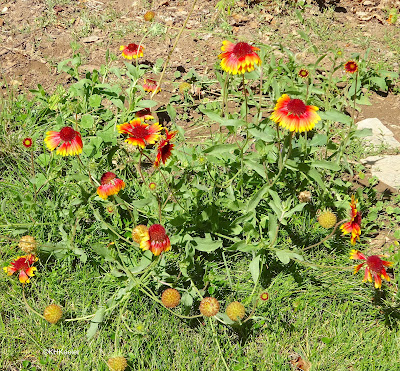 |
blanket flower, Gaillardia, native
|
What I learned recently is that native animals--butterflies and moths, but also wood-borers and leafhoppers--often cannot eat introduced plants. That makes sense to me. In fact, I used to teach that one of the reasons for species being invasive is that they left behind the animals, fungi, and bacteria that ate them, and, with very little damage in the new continent, could grow much better. I never thought about the reverse of that: the impact of nonnatives on the native food chain.

