Showing posts with label grasslands. Show all posts

Sunday, September 11, 2016

Tallgrass Prairie--the Lost Ecosystem

Romance is in the eye of the beholder. Many people find forests romantic. Many fewer love prairies.

So let me talk about tallgrass prairie.

tallgrass prairie, Nebraska

Most people have never seen a tallgrass prairie. Just two hundred years ago, tallgrass prairie extended from the forests of Kentucky and Tennessee to the middle of Nebraska and Kansas, from the Gulf of Mexico to southern Canada.

Sunday, December 6, 2015

Plant Ecology--Tumbleweeds, the Lifestyle

young tumbleweed
young tumbleweed
In the dry fall of the Front Range of the Rocky Mountains, the tumbleweeds let go and roll around.  Drifts on fences from the region make dramatic pictures link

While there are plants called tumbleweeds, actually tumbleweeding is something diverse plants do.

Sunday, November 29, 2015

The Range of Prairie Plants--Natives of Edmonton, Alberta


blanket flower Gaillardia
blanket flower Gaillardia aristida
"I know that plant!" I was 1200 miles almost due north of home, in Edmonton, Alberta at a Botanical Society meeting. I had never been that far north in Canada. There, a native garden at the Shaw Conference Centre featured plants important to the local Cree tribe. And most were plants I knew from Colorado. See blanket flowers, asters, monarda in Edmonton, below and in my "grow local natives" Denver Post article.

Sunday, October 19, 2014

Plant story: The amazing dioecious buffalo grass, Buchloë dactyloides

buffalo grass, male flowers
buffalo grass, male flowers, sticking up 

Buffalo grass, Buchloë dactyloides' (or Bouteloua dactyloides) [previous posts on buffalo grass and bison; drought tolerance, name] is a short drought-tolerant native American grass. It was one of the dominant (most common) grasses of the American high plains with a broad range from Mexico to Canada across our driest grasslands. It is highly regarded as food for cattle and bison. It is now being widely planted as a water-efficient lawn grass.

The success of buffalo grass is the more amazing to me because buffalo grass is dioecious. Dioecious means that there are male plants and female plants that have to mate before a seed is produced.

Monday, December 2, 2013

Plant Story: Rocky Mountain Bee Plant (Cleome serrulata)

Rocky Mountain bee plant, Cleome serrulata
Bees like it too.
I wrote a few weeks ago that it would be nicer if the pretty flowers on the roadside were native plants, not escaped aliens (link). One plant that fills that role in my region is Rocky Mountain bee plant, Cleome serrulata.

Rocky Mountain bee plant is a native North American relative of the cleome that is widely sold as a garden flower, commonly called spider flower (link to photo). Spider flower is Cleome hassleriana from South America. Rocky Mountain bee plant is smaller than spider flower and, as far as I know, only has purple flowers, not white,cream or pink. 

Monday, September 2, 2013

Plant story: the amazing buffalograss, Buchloë dactyloides


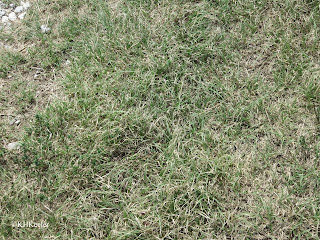
buffalo grass, Buchloë dactyloides
stand of buffalo grass, Buchloë dactyloides, 
grass family, Poaceae. Area is about 1 square yard.
  Buffalograss is one of my favorite plants. Grasses get walked over a lot, with people not even trying to tell them apart. One of buffalo grass's strengths might be recognizability. Once you learn what it looks like, it is easily recognized. The leaves are narrow green ribbons. The plant sends out runners which root and let it spread. It never grows more than 8-10" (20 cm) tall. You never have to mow a buffalo grass lawn.
herd of bison
herd of bison (old bad photo)
  For clarity I should state that I'm talking about Buchloë dactyloides, the buffalo grass that is native to the high plains of North America. There is a tall (3', 1 m) grass in southern Africa called foxtail buffalo grass which I have seen labelled "buffalo grass" online. I don't mean that buffalo grass. And, apparently South Africa and Australia call Stenotaphrum secundatum buffalo grass or buffalo lawn grass. In the U.S., the usual name for S. secundatum is St. Augustine grass. I don't mean that buffalo grass either. I mean the North American native buffalo grass Buchloë  dactyloides.
buffalo grass, Buchloë dactyloides
buffalo grass, Buchloë
 dactyloides,
closer view, area less than 1 square
foot. The grass blades are about 4"
tall.

  (I have no idea why there are dots, an umlaut, over the e. There are two syllables there, though: Buk lo ee).


   The "buffalo" in the name of the buffalo grass refers to the American bison, Bison bison, popularly called the buffalo. Buffalo grass, Buchloë dactyloides, apparently owes its distribution to the bison. And it contributed to the bison's success. In sum, they have a mutualistic relationship aiding both, even though they are grass and grazer.


Monday, February 25, 2013

Plant Confusions: Garden Sage and Sagebrush are Different


garden sage, Salvia officinalis
Artemisia tridentata, big sagebrush
big sagebrush, Artemisia tridentata
Sometimes two plants with the same name are quite different. 
     I still remember my surprise, years ago, when I realized garden sage and prairie sages were unrelated.
    The culinary herb, sage, sometimes called garden sage for clarity, Salvia officinalis, is from Europe. Although it doesn’t taste or smell minty, you can call it a mint because it is in the mint family, Lamiaceae. It is related to a host of important culinary herbs, not just clary sage, spearmint and peppermint, but also plants as diverse as lemon balm, catnip and oregano. 
garden sage with flowers