Showing posts with label spices. Show all posts

Sunday, December 8, 2024

Not Always Just Plain Vanilla, repost

I am taking a break this month, reposting previously published blogs. This one is from February 2013, the first month of this blog. And, I could not resist som editing, especially giving credit to Edmond Albius for discovering vanilla needed to be cross-pollinated. 

     Good vanilla is one of my favorite flavors, and the idea of "plain vanilla," vanilla as the no-flavor flavor, has always been somehow annoying.  And it wasn't always the case.

Vanilla orchid
The vanilla orchid is the plant in the middle, 
hanging down over the tree branch. (In the 
Conservatory at the Smithsonian in 
Washington D.C.)
   Vanilla is native to the Americas and although probably in use for millennia there, it only reached Europe after 1492. At that time it was a rare and highly desirable flavor.


   Vanilla comes from “beans,” long thin bean-like pods, but vanilla is not at all a bean (legume, plant family Fabaceae), but an orchid (plant family Orchidaceae). In fact, it is the only orchid used as a food, or used by commerce in any other way than as ornamentals (flowers) even though there are more species of orchids than species in any other plant family, legumes and grasses included.  


Sunday, March 21, 2021

Plant Story-- Wonderfully Fragrant Basil, Ocimum basilcum

basil, Ocimum basilicum

If I ranked vegetable garden plants on their beauty as plants, basil would rank high. It has shiny green leaves opposite each other on a square stem. When you crush a leaf, you smell the lovely fragrance, the reason that basil is an important herb.

Sunday, January 24, 2021

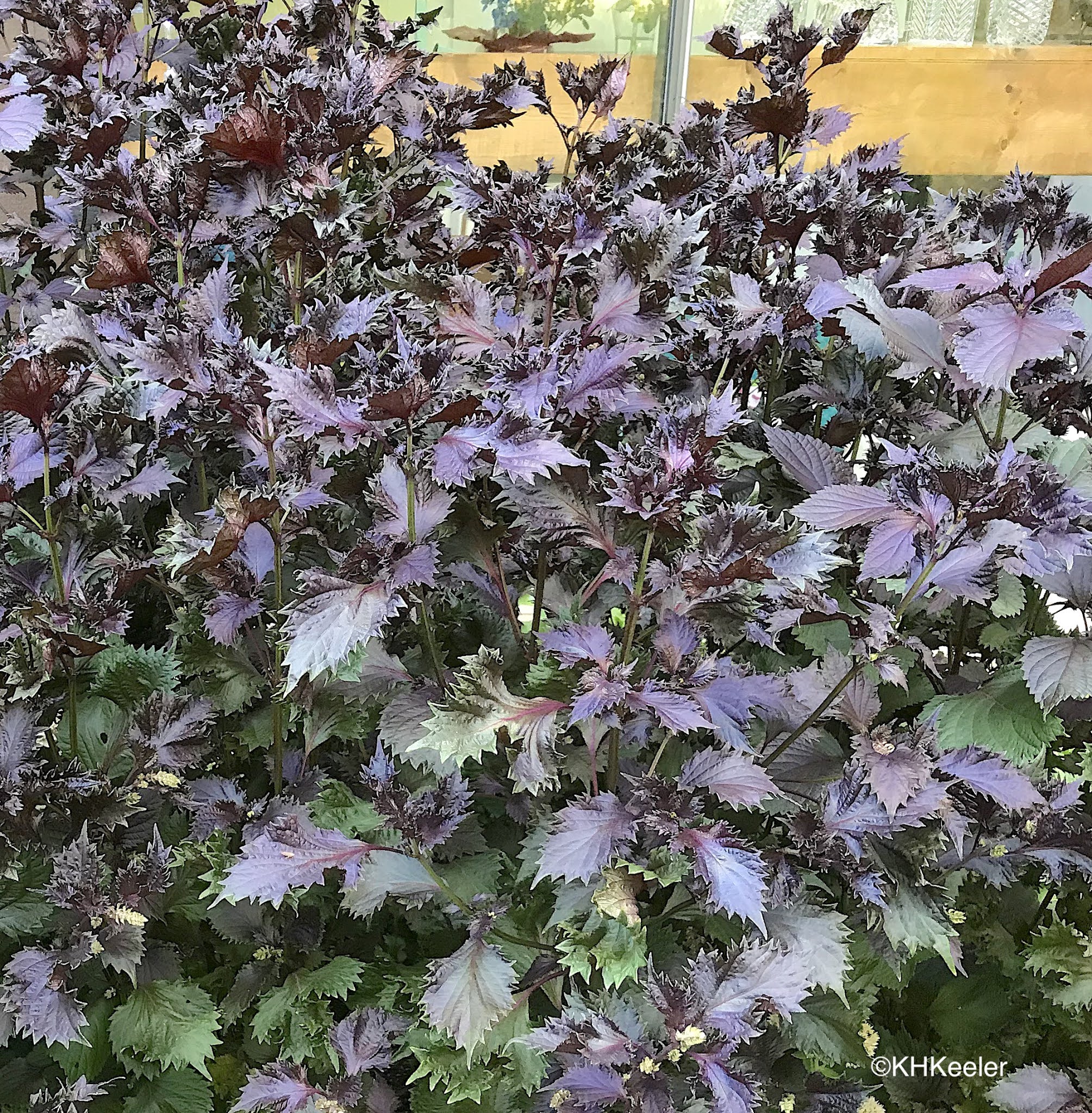
The Contradictory Plant Known as Beefsteak Plant, Shiso, and Perilla Mint, Perilla frutescens

Thirty years ago in San Francisco, influenced by Asian cuisine, my husband and I frequently sprinkled powdered shiso on our food as a spice. In Nebraska, I had a period of trying to grow everything I ate--to see what its plant looked like--so we grew a few plants in the garden. I hadn't given it much thought since, until seeing it in botanical gardens and as an ornamental in Ohio.

beefsteak plant, Perilla frutescens
beefsteak plant, Perilla frutescens, also called shiso

Sunday, October 13, 2019

Plant Story--Fragrant Oregano, Origanum vulgare

oregano, Origanum vulgare

When I was a beginning gardener, decades ago, I tried to grow all the spices of my kitchen shelf: sage, rosemary, thyme, oregano and so on. I have had oregano in my gardens ever since.

Common oregano, also called Greek oregano, pot marjoram, and wild marjoram, is Origanum vulgare in the mint family, Lamiaceae (also called Labiatae). Origanum is the Greek name for the plant, although you can read the more romantic explanation that it is a combination of óros and gános meaning "mountain splendor" or "mountain joy," perhaps both are true. The species epithet, vulgare, means "common." Oregano in native to southern Europe where it has a number of close relatives, such as sweet marjoram (Origanum majorana).

Monday, February 25, 2013

Plant Confusions: Garden Sage and Sagebrush are Different


garden sage, Salvia officinalis
Artemisia tridentata, big sagebrush
big sagebrush, Artemisia tridentata
Sometimes two plants with the same name are quite different. 
     I still remember my surprise, years ago, when I realized garden sage and prairie sages were unrelated.
    The culinary herb, sage, sometimes called garden sage for clarity, Salvia officinalis, is from Europe. Although it doesn’t taste or smell minty, you can call it a mint because it is in the mint family, Lamiaceae. It is related to a host of important culinary herbs, not just clary sage, spearmint and peppermint, but also plants as diverse as lemon balm, catnip and oregano. 
garden sage with flowers