Showing posts with label tropical plants. Show all posts

Monday, September 16, 2024

Plant Story--The Beautiful Roselle, Hibiscus sabdariffa

The roselle is a small hibiscus, Hibiscus sabdariffa, (cotton family, Malvaceae) that is grown as food, but pretty enough to be grown as an ornamental. Also known as Jamaican sorrel, roselle is a tropical perennial which can be grown outside the tropics as an annual. The stems are red, the leaves green, the veins in the leaf red. The flowers are white or yellow with dark centers. Around each flower are a series of fleshy red sepals and another circle of red bracts that look very similar. The sepals are gathered and eaten, sometimes under the name "hibiscus flowers."

roselle, Hibiscus sabdariffa

Sunday, April 30, 2023

Beach Lettuce, Fan Flower, Beach Naupaka, Scaevola taccada, Native and Ornamental

This is the story of a successful native. Beach lettuce, fan flower, Scaevola taccada, grows on beaches across the Pacific Ocean. Called beach naupaka in Hawaii, it is one of about 600 species of plants native to Hawaii, having reached the islands, the most remote in the world, without human help. Since it is found on beaches all over the Pacific, Hawaiians call it indigenous rather than endemic. It is a conspicuous plant to beach-goers, growing abundantly just above the tide line. 

beach naupaka Scaevola taccada, Honolulu

I want to praise it for its role as an ornamental. 

Sunday, December 16, 2018

Homogenized World--Attractive and Useful Tropical Plants

I wrote recently that the wonderful trees of any particular location in the modern tropics were drawn from all over the world, many of them in the 16th century as Europeans explored and colonized.

The same applies to smaller plants

Pineapples (Ananas comosus, bromeliad family, Bromeliaceae), popularly associated with Hawaii, are from Central America and the Caribbean.
young pineapple


Tuesday, November 20, 2018

Homogenized World--Tropical Plant Distributions

Caribbean beach

I am writing a novel about Paraguay in 1630--because when I saw northern Argentina and Paraguay in the 1980s I was surprised by their natural history and history and have wanted to share their stories.

In trying to bring the 17th century to life, I have to describe what was there and that has been quite an adventure because there has been so much change.

Beginning in the 1500s, conquering and colonizing, European powers carried useful plants all over the world. To describe our world early in that process, I have to figure out what plants are native to the Americas and which were introduced. If it is native to the Americas, it will likely be new to Europeans. If it is from Africa or China, it may not yet be common in South America even if it is abundant there today.

Sunday, November 11, 2018

Winter Escape--Honolulu

As the days get colder, I daydream about tropical beaches.

For example, in Hawaii
Waikiki, Honolulu

While I always recommend the Big Island if you are going to Hawaii (for its diversity and its active volcano) I recently did a successful experiment--I had a great botanical time from a single hotel in a easily-reached city. We simply flew to Honolulu last May, stayed in a hotel there, and explored from there.
Diamond Head, Honolulu
View from hotel window

Sunday, October 28, 2018

Plant Story--Papaya, Tropical American Fruit

papayas for sale
You see them sometimes in northern markets, green-orange fruits looking like small footballs. And I presume sometimes they taste pretty good.

But pretty good is not how they taste in Florida or Hawaii or Costa Rica. A really fresh papaya is a marvelous thing.

a bowl of papaya
a dish of fresh papaya

Sunday, September 23, 2018

Plant Story--Castor, Tall, Beautiful and Deadly

castor, Ricinis communis
When I was a child, castor oil was a tonic commonly given to children. It was oily and we resisted.

In those days, I was told the plant that castor oil came from was called the castor bean. Although you still see it, the name castor bean is "out" today, because usually beans are plants in the pea family, legumes (Fabaceae) and castor, Ricinus communis, is a spurge, related to croton and poinsettia (Euphorbiaceae). You will see castor oil plant or just castor as we struggle to say it better.

You can see why the name: the seeds do look like beans.
Seeds of castor, Ricinis communis
Castor oil has been an important oil for millennia, but castor is a very poisonous plant.

Sunday, March 25, 2018

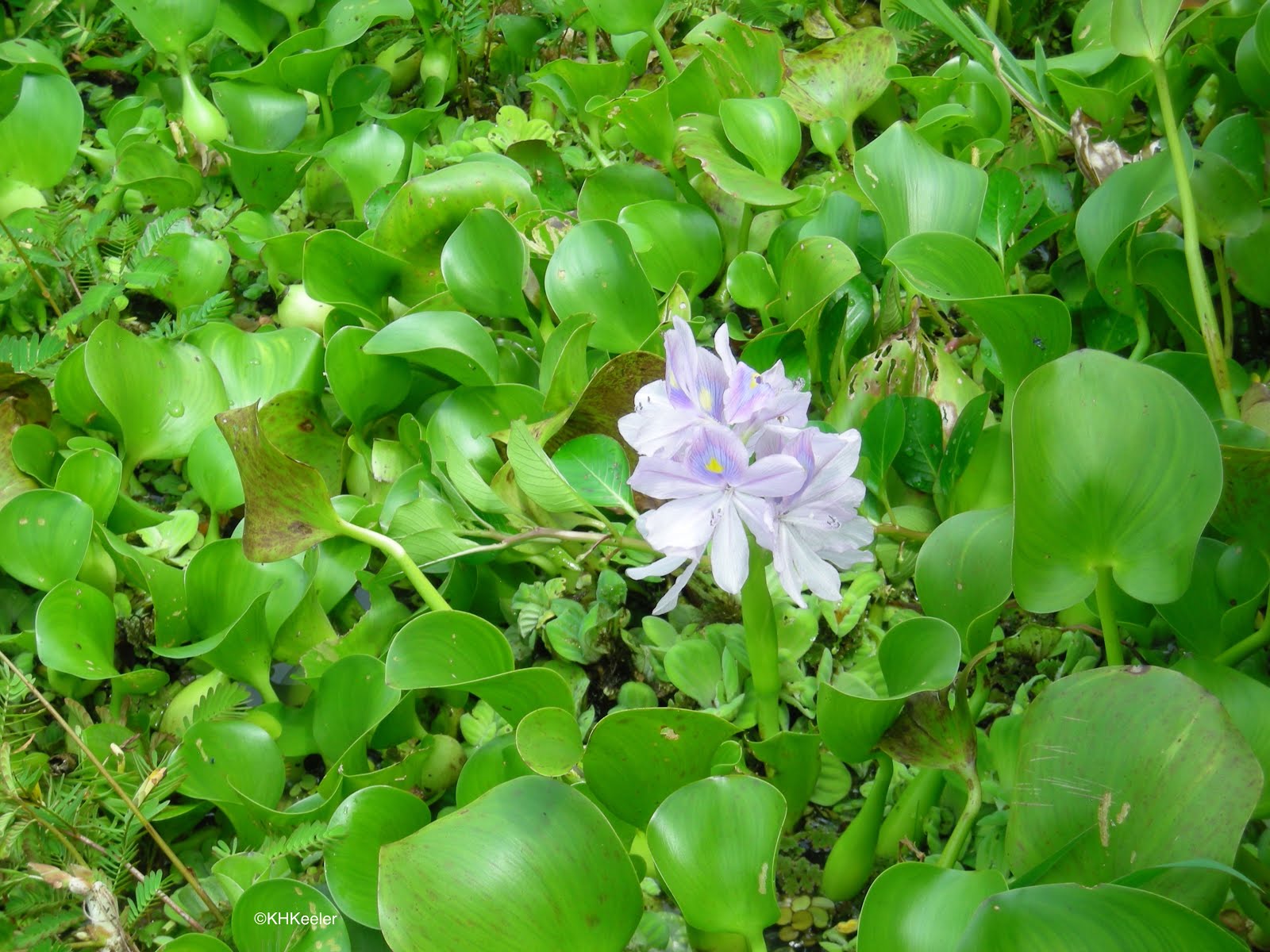
Plant Story--The Beautiful Horrible Water Hyacinth

water hyacinth, Eichhornia crassipes
Floating water hyacinth, Eicornia crassipes
The water hyacinth is one of the plants I treasure because I learned about it before I knew what it looked like. Therefore, one day I had a moment of joy when all things I knew about it came together.

You see, there was Eichhornia crassipes with the complex breeding system, water hyacinth the terrible weed of subtropical lakes and streams and that handsome aquatic plant for sale at garden shops.

What? They're the same plant?

Yes indeed!

Sunday, March 4, 2018

Plant Story--Coral Trees, the Erythrina species

Erythrina, coral tree


Pretty red flowers on a small tree, the flowers upturned or curved like crescents. Called coral trees or coral bean, the genus is Erythrina in the pea family, Fabaceae, and they are found all around the tropical world.

My most recent encounter with a coral tree was with Erythrina crista-galli, the cockspur coral tree (crista-galli is Latin for cock's comb) in Argentina, where, called ceibo, it is the national flower. Cockspur coral tree is native to northern Argentina and nearby areas in Paraguay, Uruguay and southern Brazil. It is the national flower of Uruguay, as well.

Which tells you how spectacular the cockspur coral tree is in flower.

Sunday, January 28, 2018

Plant Story--So Exotic, Bird of Paradise Flower

The bird of paradise flower, Strelitzia reginae, is so commonly planted in tropical and subtropical climates--southern California, Florida, Hawaii in the United States--as to seem boring.

Strelitzia reginae bird-of-paradise plant


At the same time, for newcomers to those and more tropical regions, it is the essence of an exotic flower: very large, bizarrely shaped and in incredible blue, orange, red and green.

Sunday, January 7, 2018

Sunday, December 24, 2017

Plant Story--Amaryllis, well, actually Hippeastrum

Amaryllis, the big bulbs that are often given as holiday gifts because the flowers that emerge are so glorious, are in the genus Hippeastrum not the genus Amaryllis. The naked ladies that bloomed in the garden in August, those were Amaryllis.

Scientific name Hippaecastrum, common name amaryllis

Sunday, November 19, 2017

Plant Story--Perplexing Pumpkins

We have no problem recognizing pumpkins

pumpkins

and yet, botanically they're difficult.

Four plant species are "pumpkins": Cucurbita moscata, Cucurbita argyrosperma, C. maxima and Cucurbita pepo.

That would not be particularly confusing, except that those same plant species also give us summer and winter squashes. Thus, different varieties of Cucurbita pepo, for example, are acorn squash, zucchini and sugar pumpkins.

Sunday, May 7, 2017

Plant Story--The Dramatic Heliconias

Heliconias, Bali
Heliconias, Bali
I traveled halfway around the world, to tropical Asia, and the iconic plant I saw everywhere is one I associate with the American tropics, heliconia.

In Bali, the gardens there were glorious with heliconias.

Heliconias, Bali

But heliconias, also called crab's claws and even Japanese canna, are plants in the genus Heliconia, native to the New World tropics. I first met them in Costa Rica, and admired them where they grew in open spots in and along the lowland rainforest.

Sunday, January 22, 2017

Tropical Flowers

orchids
orchids,  Singapore
Here is are a group of bright flowers, in case you are deep in snow as I am, are heading for a tropical holiday, or just enjoy the dramatic colors -- a collection of common tropical flowers. The tropics are defined as between the Tropic of Cancer and the Tropic of Capricorn, the area around the Equator between 23 degrees north and south. Except at high elevations, this region never freezes and is generally quite warm and rainy.

All over the tropics you'll see:

Orchids! Members of the Orchidaceae, the plant family with more species than any of the other 400+ plant families, orchids have great diversity, from small pale flowers to large purple or red ones. People love them, so there are thousands of cultivated varieties. The vast majority of orchids require warm temperatures and high humidity so are easily grown in the warm tropics and less visible elsewhere.

orchids
another orchid seen in Singapore

Sunday, January 15, 2017

Plant Story -- the Mysterious Marquis Frangipani

The Marquis Frangipani eludes me.

plumeria

Frangipani, Plumeria, (link: previous post) is one of the plants where the common name is no easier than the scientific name: both are multi-syllable words unfamiliar to most people. The scientific name is Plumeria. That name was chosen by Linneaus in the middle 1700s in honor of the Franciscan monk and French botanist Charles Plumier (1646-1704, biography), who collected and described many plants in the Caribbean in the late 1600s, one of which was plumeria. The plant was of course well-known to native Americans across the Caribbean and central America. The Badianus Manuscript, 1552, describes it and its use by the Aztecs, but The Badianus Manuscript was not widely known or available for many years after it was written (link).

Sunday, January 8, 2017

Plant Story--Fragrant Plumeria, Frangipani, Temple Tree

I first saw it in Costa Rica in 1972. A beautiful plant with spiral white flowers and an enticing scent. Plumeria the biologists told me.

wild frangipani, Costa Rica 1973
Several days later someone called it frangipani and I connected the little bottle from the New Age store with the beautiful flower.

But it is true. One common name for species of Plumeria is frangipani and it is the source of what I thought of as a rather cloying essential oil. I like the scent of the flowers much better. If you've never smelled a frangipani flower, you've missed a treat!


Sunday, November 20, 2016

Dye Story--Cochineal Reds

The big prickly pear cactus had white deposits. So unsightly! And yet, the source of fortunes!

Opuntai with cochineal

Humans love red, but red dyes are few in the natural world. Europe from prehistoric times raised madder (Isatis tinctoria) which makes a strong brick red. But though they loved madder, Europeans liked colors that were almost purple even better, and those were harder to produce. The Phoenecians, Greeks and Romans made them from small molluscs (murex, link  link) gathered in the Mediterranean. That was the source of the rare royal purple of Roman togas, a red-purple. The snails were over-harvested and when Constantinople fell to the Turks in 1453, the technology was lost until the 19th century.

Sunday, November 6, 2016

Visiting Singapore--Gardens by the Bay


We stood astonished. Huge metal "trees."  This was Singapore. On the Equator, with lush plants but also industrialized and high-tech. So: a tree-like metal framework for tropical vines.

Gardens by the Bay, Singapore
   
Here is how they looked from a distance, from a second or third story walkway.

Sunday, October 30, 2016

Plant Story--Marigolds from the Americas

So, who are the marigolds, genus Tagetes?

marigolds, Tagetes
marigolds, Tagetes
The previous post (link) was about calendulas, called marigolds, now more properly called pot marigolds, important plants through much of European history. In the 1500s, a different group of flowers, species of the genus Tagetes (sunflower family, Asteraceae) were introduced to the Old World from the Americas. People loved them, called them marigolds and presently they became the plants people recognized as marigolds, not the Eurasian calendulas.

Marigolds, Tagetes, were not wildflowers when they were brought to Europe (by 1520). The Aztecs and other Native American groups had been growing them for centuries.