Showing posts with label milkweeds. Show all posts

Sunday, October 22, 2023

Grow Native Plants. Part 1: Why?

The conservation community is urging people to grow plants native to their area. At the same time, you can find articles arguing against planting cultivars of native species. It is difficult, buying a native plant, to figure out how to avoid a cultivar. And why should you? This is a big topic. I'll cover it in a series of posts. First, why grow natives at all?


beebalm, Monarda and blackeyed Susans Rudbeckia
Natives beebalm, black-eyed susans and a bit of grass

Wednesday, June 1, 2016

Where to Buy Milkweeds to Grow in Colorado

Colorado, straddling the Rocky Mountains, has, on the eastern side--Front Range--monarch butterflies from the eastern North American population and on the Western Slope, butterflies from the western monarch population. Colorado doesn't fit neatly into the current "Grow Milkweeds for Monarchs!" push because the common milkweed, Asclepias syriaca is not native here.

Monarch caterpillars eat only milkweeds, so reductions in milkweed populations reduce monarch butterfly numbers.
showy milkweed, Asclepias speciosa
a Colorado milkweed
showy milkweed, Asclepias speciosa
Milkweeds are native all across North America--there are 140 species--but that "weed" in their name makes us assume they are ubiquitous. Far from it. Planting milkweeds to help monarch butterflies find it easier to find food for their larvave makes very good sense.

The common milkweed (A. syriaca) doesn't grow in Colorado. Since there are 19 species of milkweed native to Colorado, it only makes sense to grow those. The easiest to grow is the showy milkweed, Asclepias speciosa It is the milkweed you see in Colrado side-lots and roadside ditches. It looks a lot like the common milkweed.

Sunday, October 11, 2015

Milkweeds, Monarch Butterflies and Colorado

"Plant milkweeds!" they say. But which ones?
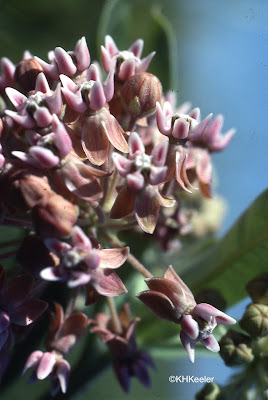
common milkweed, A. syriaca
common milkweed, Asclepias syriaca
The number of monarch butterflies (Danaus plexipus) seen in the eastern United States has declined dramatically over the last couple decades. Monarch experts, e.g. Drs. Lincoln Brower and Orley Taylor, make a strong case that the decline has been caused by several factors: First, 1), changes in agriculture in the U.S. midwest that have reduced the number of milkweeds for monarch butterflies to feed upon. In particular, use of herbicide-resistant crops eliminated the common milkweed, Asclepias syriaca (dogbane family, Apocynaceae) which had been growing as a weed in the corn and soybeans. Simultaneously, high prices for corn and soybeans, now used for biofuels (ethanol) as well as human and animal food, favored expansion of weed-free cropland into areas that previously supported wild plants including milkweeds. Another cause of monarch butterfly decline is, 2), loss of forests in their overwintering grounds in Mexico, due to illegal logging and poor management. In addition, 3), periods of unfavorable weather reduced growth of monarchs and allowed their natural enemies, from birds and ants to fungal diseases, to find and kill them. (See the Taylor lecture with all the data; link). To counter the decline in monarch butterflies, many changes may be required, but much can be done by having more milkweeds available for the butterflies. Monarch butterfly caterpillars eat milkweeds and accept no substitutes. Consequently, concerned experts and citizens urge planting milkweeds so that there is ample food for monarch caterpillars. Adult butterflies get norishment for the nectar from flowers of many plant species so adult food is rarely an issue.

milkweeds in Colorado
wild milkweeds in Colorado, showy milkweed
If a major part of the problem is reduction in milkweed numbers, then planting milkweeds is a very effective response. To aid that, a variety of organizations are advising people all across North America to plant milkweeds, providing links and advice, and in some cases giving away milkweed seeds. (Monarch Watch, Save our Monarchs, Xerces Society )

However, not everyone should just write away for free seeds and toss them into their yard. My concerns are from the point of view of growing well-adapted native plants. If the plant dies, you've wasted your time and energy and any monarch caterpillars relying on it die too. Conversely, introducing troublesome new weeds would be an undesirable outcome of this campaign. Plant the right milkweed for your area.

Monday, October 7, 2013

Botany Rules: Why Change Scientific Names?! Part 2


Helianthus pauciflorus
stiff sunflower Helianthus rigidus
when the photo
was taken, now Helianthus
pauciflorus
     Plant names of American plants are changing more right now than they have for centuries because of the joint impact of the Flora of North America Project and DNA sequencing. I talked about the Flora of North America project last post.  LINK   

  There would certainly have been changes in American plant names as a result of the writing of the Flora of North America, but the concurrent emergence of DNA sequencing has produced surprising new data to integrate. 

      Compared to animals, plants have a simple structure. Botanists recognize only three tissues: root, stem and leaf. Flowers and fruit are specialized leaves. From descriptions of the arrangement and details of these three tissues botanists created plant classification. They used all the tools they had: complex measurements, chemical analysis, geographic patterns, and ability to hybridize, for example. 
  
     After 400 years of applying these techniques, plant biologists thought they were pretty close to having found the true relationships among plants. They were wrong. DNA data has revealed many surprises. In particular, it has shown convergence, where two plants look very similar but turn out not to be closely related at all. For example, flowering plants living in ponds or streams have similar characters for living in or under water, but their ancestors are found all over the plant kingdom.