Showing posts with label Asteraceae. Show all posts

Sunday, July 30, 2023

Plant Story--Orange Mountain Dandelion, Agoseris aurantiaca

Orange mountain dandelion is a an easily-recognized native wildflower of cool areas in western North America.

orange mountain dandelion Agoseris aurantiaca

It looks a lot like a dandelion but it is the wrong color. Closer inspection picks up more differences, such as leaves that don't have the characteristic jagged pattern of dandelions, bracts under the flower are upright rather than pointing down the stem as in dandelions, and more. So you can identify it as resembling a dandelion, not a daisy or sunflower, and the flower color is an immediate tip-off it is not the common dandelion (Taraxacum officinale).

Sunday, December 11, 2022

Plant Story--Burdock, Arctium, Burs, Vegetable, and Velcro

Burdocks are plants you recognize for their seed pods or leaves. Oh, they have pretty enough pink-purple flowers, much like thistles flowers, but the seed pods have spines with hooks that stick tightly to clothes or fur, and the leaves are very large.

burdock, Arctium
burdock, Arctium

Sunday, October 2, 2022

Plant Story -- Orange Hawkweed, Hieracium aurantiacum

I grew up calling it Indian paintbrush, so when I went west and was shown Indian paintbrush, I was puzzled. Currently, the websites say hawkweed is Hieracium, and Indian paintbrush is Castilleja. No relation between them. So I've learned to call the plant hawkweed. Actually, orange hawkweed, Hieracium aurantiacum or Pilosella aurantiaca.

orange hawkweed, Hieracium aurantiacum

Sunday, November 10, 2019

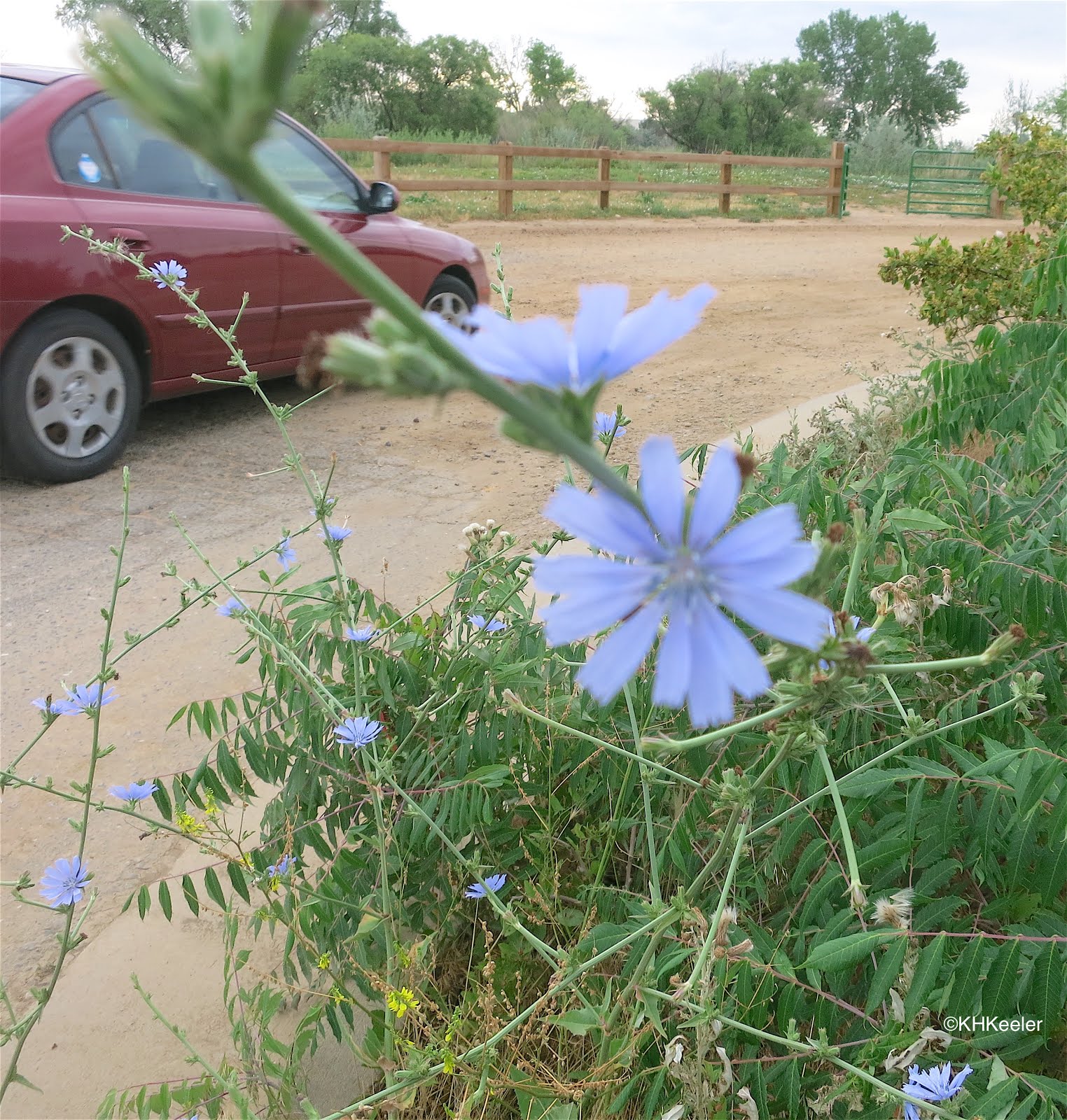
Plant Story--Chicory, Roadside Blue

chicory flowers

You see chicory on the roadside during the morning commute, a splash of bright blue. Coming home, you don't notice it. When you think about it, the blue flowers aren't generally out in the fields either.

Sunday, July 28, 2019

Plant Story--Ox-Eye Daisy, Leucanthemum vulgare,

ox-eye daisy, Leucanthemum vulgar
ox-eye daisy, Leucanthemum vulgare
The daisy (see photo) was probably the first flower I could recognize. Daisies grew all over the fields of central Pennsylvania and upstate New York where I was a small child. To me they represented "flowers."

I have since discovered this daisy is a European plant naturalized all over North America--a weed--and that it is not "the daisy" but the ox-eye daisy (Leucanthemum vulgare) because another plant was England's "the daisy," the smaller plant I used to call lawn daisy, Bellis perennis (below) when I noticed it al all.
lawn daisy, Bellis perennis
daisy, lawn daisy, Bellis perennis

Sunday, July 7, 2019

Plant Story--Coneflowers, Echinacea and Ratibida, American Wildflowers

Two often-cultivated American wildflowers go by the common name coneflower, plants in the genus Echinacea and those in the genus Ratibida. 
coneflower, Echinacea
coneflower, Ratibida

Sunday, June 24, 2018

Plant Story--Native Wildflower, Gumweed, Grindelia

Grindelia, gummend

Gumweeds, genus Grindelia (sunflower family, Asteraceae) are roadside wildflowers, most common in western North America but with a few species in the East and South. A gumweed is easy to recognize: note the funny spines around the flower buds (especially visible in the picture below). In addition, gumweeds are gummy--if you touch the buds or flowers, sticky stuff comes off on your fingers.

But there is a lot more to gumweeds.

Sunday, October 23, 2016

Plant Story--Marigolds in History-- Pot Marigolds (Calendulas)

marigolds, Bali
marigolds, Ubud, Bali, Indonesia

Marigolds and calendulas are mixed up in the literature (previous post). Both are plants with yellow to orange flowers in the sunflower family, Asteraceae. Calendulas, Calendula officialis, are from southern Europe or the Near East, and over the last 1000 years were called marigolds or pot marigolds in the European literature. Marigolds, species of Tagetes, are native to the New World and were introduced to the Old World in the 1500s. Lacking English names originally, they were initially called French marigold (Tagetes patula) and African marigold (Tagetes erecta) in England. Today the Tagetes species are generally called marigolds and the calendulas (pot marigolds) are much less well known.

Sunday, October 16, 2016

Plant Confusion -- Marigolds and Calendulas

The marigold has conquered the world. Marigolds are common enough that we don’t pay them much attention. Look: marigolds in Bali:

marigolds,Bali
marigolds, Ubud, Bali, Indonesia

and Taiwan
marigolds, Taipei, Taiwan
In Asia, they are very much loved...and a long way from home.

Sunday, August 21, 2016

Common Names--What a Mess!


saskatoon
Saskatoon berries, or you might know them as...
Here are the fruits on my saskatoon--you might know them service berries or June berries. In the East you might call this a shadbush. Robins don't argue over the names, they just gobble the fruits down.

To entertain with the stories I love, I have to identify the plant. That is what names are for--communication. Why is it so difficult to have widely recognized plant names?

Sunday, August 7, 2016

Plant Story--Wavy Leaf Thistle, A Pretty Native, Not A Weed


Cirsium undulatum, wavyleaf thistle

Wavy leaf thistle, Cirsium undulatum, is a native thistle of the plains and the west of North America (sunflower family, Asteraceae). Thistles are a weird group: some are rare and endangered, some are extremely abundant noxious weeds. Wavy leaf isn't currently protected, but it is closer to being rare than noxious.

Sunday, August 9, 2015

Plant Story--Bachelor Buttons and Cornflowers, Centaurea cyanus

Centaurea cyanus

Cornflower? Why would they call it a cornflower?

That is a typical American reaction to the English name for a bachelor button, Centaurea cyanus.

The story is this:

Sunday, June 28, 2015

Plant Story--Beautiful Blanket Flower, Gaillardia

Blanketflower, Gaillardia, is a native you probably know as a garden flower. Native garden flowers are not all that common.
blanket flower, Gaillardia

Recently, talking and writing about garden flowers, I looked at the origins of common garden flowers and noticed that only a few of them are native to central North America. The simplest explanation is time. Europeans first encountered these American plants in the early 1800s, so that's the earliest that they might have been considered for European-style flower gardens. In contrast, many European and Asian plants have been grown in gardens for 2,000 years. The consequences of long periods in cultivation include familiarity--how often do we favor the plants we grew up with? In addition, cultivation changes plants to make them more attractive in gardens, creating multiple colors, multiple sizes (for example, dwarf varieties), doubled flowers, high and predictable seed germination, good survival of transplanted cuttings. It reduces undesirable characteristics such as spines and aggressive spreading. Roses, lilies, most iris, crocuses, peonies, dahlias, daffodils and narcissus, tulips, and lilacs--to name a few--are all from Eurasia.

Sunday, April 26, 2015

Plant Story-- Yellow Salsify, Tragopogon dubius, Weedy and Edible

Yellow salsify, a plant I always called goat's beard, Tragopogon dubius, is coming up as a weed all over my garden. Right now it looks like the picture below, a spidery little plant.

yellow salsify

Sunday, August 17, 2014

Dye Plant--Sawwort, Serratula tinctoria, Obscure Historic Yellow Dye

Persian knapweed Centaurea dealbata
Persian knapweed Centaurea dealabata
Note added August 24, 2015: I had the identification of the plant wrong. Yet most of the post is correct because I talk about my experience with the plant separately from my research on dye history. I will make changes below in this font so it is clear. I have changed all the plant identications. I won't change the post title.

I like rescuing plants. You know, taking a sickly little plant, giving it good light and regular water and watching it recover. My relationship with sawwort--Persian knapweed really-- began that way. 

I was new to Colorado in fall of 2006 and finding plants for the yard of my new house. So I was looking on the end-of-the-season garden racks for promising marked-down perennials at McGuckin's Hardware Store in Boulder ("Colorado's Favorite Store"!). I chose a pot or two and got chatting with the clerk. She pointed me to the edge of the garden shop where a couple of run-down, sad-looking plants slumped over the edge of their pots and said I could have them, no charge. How could I resist?!


Sunday, April 13, 2014

Plant Story - Yarrow, Achillea millefolium, a plant species complex

Achillea millefolium, yarrow
Yarrow, Achillea millefolium (sunflower family, Asteraceae) is a small perennial plant found around the world. It is a medicinal herb in both modern and traditional medicines (see previous post: link) and is an attractive, easily-grown garden flower and in some places, a weed.


Very few plant species are listed as native to Europe, Asia and North America but that is the case for Achillea millefolium.  

Actually, yarrow is what botanists call a species complex. I will outline the situation as I understand it, because this sort of complexity is surprisingly common in plants, although yarrow does it particularly well.


Sunday, April 6, 2014

Plant Story-- Yarrow, Achillea millefolium, an Ancient Healing Herb

Achillea millefolium yarrow
Achillea millefolium yarrow
Yarrow, Achillea millefolium, is a familiar  wildflower with an interesting and confused history. A member of the very large sunflower family, Asteraceae, it is quite closely related to wild and cultivated chamomiles.


Yarrow was named Achillea millefolium by Linnaeus in 1753. The genus name is based on the idea that Achilles, Spartan hero and demigod in the Iliad of Homer, used yarrow to heal wounds. I wanted to include the exact quote and was surprised by what I found. The Iliad never mentions yarrow. The healing passage, paraphrased frequently as "Achilles used yarrow to heal his soldiers" is quoted below and is both quite vague and has the healing done by Patroclus. (Bk XI:804-848 Patroclus tends Eurypylus’ wound. Iliad A.S. Kline 2009 Read the whole passage: link )

    The wounded Eurypylus replied:...'help me to my black ship, and cut out the arrow-head, and wash the dark blood from my thigh with warm water, and sprinkle soothing herbs with power to heal on my wound, whose use men say you learned from Achilles, whom the noble Centaur, Cheiron, taught. ...’

       ... Patroclus lowered the wounded man to the ground, and cut the sharp arrow-head from his thigh. Next he washed the dark blood from the place with warm water, and rubbing a bitter pain-killing herb between his hands sprinkled it on the flesh to numb the agony. Then the blood began to clot, and ceased to flow.

Alternatively, Achilles is reported to have healed the festering spear wound of King Telephus of Mysia. This appears not in the Iliad but in other sources of Greek mythology (see citations). In any event, the spear wound of Telephus is cured by scrapings from the spear that caused the injury, suggested by Odysseus, not Achilles, and no mention is made of yarrow. (See whole myth: Telephus)

Monday, October 21, 2013

Plant Story - Garden Cosmos, Colorful and a Little Bit Wild


garden cosmos, Cosmos bipinnatus
We had three nights of killing frosts and in the yard, my beautiful cosmos are all dead. These pictures are how it WAS.
garden cosmos
garden cosmos


The boquets I picked three days ago are all that remain.
garden cosmos