Showing posts with label edible plants. Show all posts

Sunday, July 12, 2026

Plant Story--Balloon-Flower, Platycodon grandiflorus, Ornamental, Food, and Medicine

  Balloon-flower is a pretty ornamental from Asia. 

balloon-flower, Platycodon grandiflorus

Balloon-flower is sufficiently unique that there is only one plant in the genus Platycodon, the balloon-flower, Platycodon grandiflorus. It is in the bellflower family, Campanulaceae.

Sunday, May 12, 2024

Plant Story - Flixweed, Tansy Mustard, Herb Sophia, Descurainia sophia, Weedy Spring Mustard

 As a group, the plants in the mustard or cabbage family, Brassicaceae, are cool weather plants, growing well early in the spring, flowering as the temperatures warm, going to seed in the heat of summer. Familiar mustards are cabbage (Brassica oleracea), broccoli (Brassica oleracea), and mustard itself (mustards are species of Brassica, Rhamphospermum and Sinapsis). These edible mustard family plants were domesticated in Eurasia and they are a small selection of the more than 3,700 species worldwide. North America has 634 native species in the mustard family. It also has more than 100 exotic mustards. 

Flixweed, Descuriania sophia
the plant this blog is about 

Sunday, September 3, 2023

Plant Story -- Common Mallow, Malva neglecta, Edible Minor Weed

 You stop for a moment: what is that pretty white flower? 

common mallow, Malva neglecta

Then you look down and think, "oh just a weed."

Sunday, December 18, 2022

Plant Story--the Lovely, Spicy Nasturtium, Tropaeolum

 Nasturtiums are easily-recognized garden flowers. They have big orange (or red or yellow) flowers with a long spur and interesting round leaves with the stalk (petiole) in the center. They are also edible.

nasturtium, Tropaeolum
nasturtium, Tropaeolum 

Sunday, December 11, 2022

Plant Story--Burdock, Arctium, Burs, Vegetable, and Velcro

Burdocks are plants you recognize for their seed pods or leaves. Oh, they have pretty enough pink-purple flowers, much like thistles flowers, but the seed pods have spines with hooks that stick tightly to clothes or fur, and the leaves are very large.

burdock, Arctium
burdock, Arctium

Sunday, August 14, 2022

Plant Story--Purslane, Portulaca oleracea, Nutritious and Weedy, Everywhere

Purslane (Portulaca oleracea, purslane family Portulaceae) is a very widespread, common plant. 

purslane, Portulaca oleracea

So much has been written about it that mostly I'm going to remind you to notice it.

Sunday, October 4, 2020

Plant Story--Lupines, Little Wolves

Lupines, also spelled lupins, are plants in the pea family native (Fabaceae). More than 200 species are recognized, found native all across the world but especially the Americas. (Lupines in Texas and surrounding states are often called bluebonnets.) These are distinctive plants, the leaves tending to be compound with five or more leaflets projecting out from the center so they are hand- or star-like. The flowers are a tall spike of closed, pea-like blossoms, in colors from white to yellow to pink, blue, and purple. 

lupine, Lupinus, flowers and leaves

Sunday, September 2, 2018

Edible Plants--Conflicting Stories

elderberry, Sambucus, in flower
elderberry, Sambucus, with unripe berries
Finding out whether a plant you want to gather and eat is safe to eat can be confusing. For some plants, you can quickly find sources that say both "yes it is poisonous" and others that say the exact opposite, "no, it isn't poisonous." Two examples are black nightshade (Solanum nigrum, tomato family Solanaceae) and elderberries (Sambucus spp., elderberry family, Adoxaceae). Both are described on the internet as both edible and poisonous. (Solanum examples: link link link) (Elderberry examples link link link)

a nghtshade, Solanum
a nightshade, Solanum species
Three issues underlie these contradictions: 1) cautious publications, 2) geographical variation with sloppy identification and 3) quantity.

Sunday, May 13, 2018

Plant Story--Daylilies, From Asia, Beautiful and Not Lilies

day lily Hemerocallis
Everyone always has grown daylilies and their story is well-known. It seemed. When I looked carefully, I totally rewrote this blog post.

Daylilies have been in U.S. gardens since the 1600s. It is commonly reported that both Dioscorides and Pliny in ancient Rome (1st century AD) wrote about them, but careful analysis has shown they were describing a lily, not a daylily. Daylilies came to the West from China, after 1500.


Sunday, December 4, 2016

Edible Plants--What is an Edible Plant?

Berberis

One of the things people like to ask about a plant: Is it edible?

That is probably not the right question.

Sunday, March 8, 2015

Plant Story--redstem stork's bill, Erodium cicutarium--early to flower!

On January 29, I found a plant flowering in northern Colorado at 5000' elevation--when it should be winter but there had been a warm spell. That plant was Erodium cicutarium, redstem stork's bill. It is a geranium relative from around the Mediterranean in Europe (family Geraniaceae).

Erodium cicutarium, redstem filaree
Erodium cicutarium, redstem stork's bill, flowering in January in Colorado

Sunday, November 23, 2014

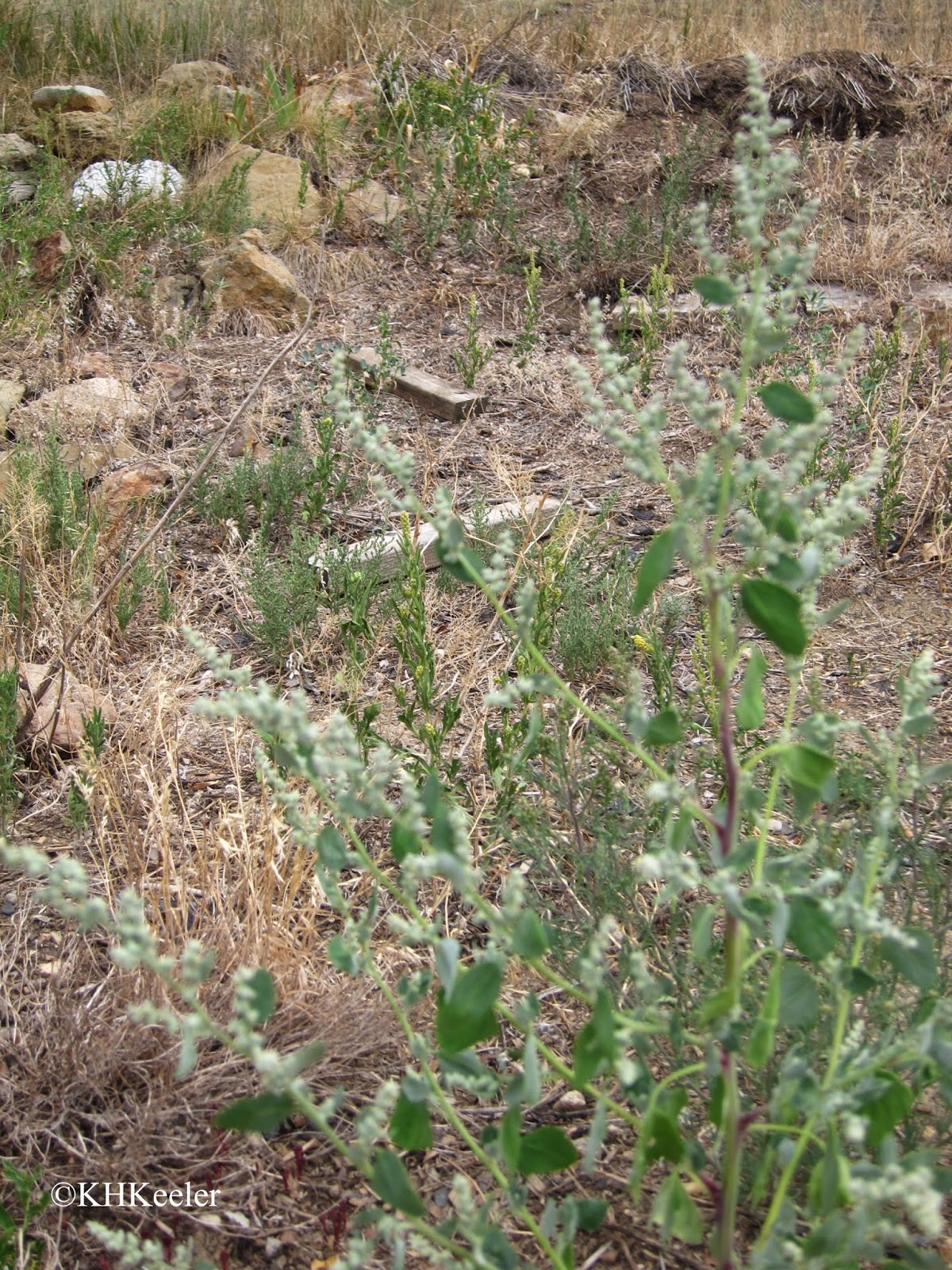
Plant Story--Chenopodium album, aka lambsquarters and fat hen

Chenopodium album, Amaranthaceae
Chenopodium album is a Eurasian plant that has established itself across most of the world. But you may well walk by it without noticing.

Chenopodium album is in the plant family, Amaranthaceae, the amaranth or pigweed family. Many places you will see it listed as having its own family, Chenopodiaceae, but recent work merged the Chenopodiaceae into the Amaranthaceae. 

The scientific name says "white goose foot", the chen for goose in Greek,  podium foot, and album is white. The flowers are whitish, but so are the new leaves (picture above) so while the namer might have meant the flowers, I see white on every plant.


Chenopodium, Amaranthaceae
Chenopodium album, Amaranthaceae
Part of what is the most fun with C. album is getting someone else to realize they know it. It goes by so many common names that it can hide in plain sight. For example: