Showing posts with label dandelion. Show all posts

Sunday, July 30, 2023

Plant Story--Orange Mountain Dandelion, Agoseris aurantiaca

Orange mountain dandelion is a an easily-recognized native wildflower of cool areas in western North America.

orange mountain dandelion Agoseris aurantiaca

It looks a lot like a dandelion but it is the wrong color. Closer inspection picks up more differences, such as leaves that don't have the characteristic jagged pattern of dandelions, bracts under the flower are upright rather than pointing down the stem as in dandelions, and more. So you can identify it as resembling a dandelion, not a daisy or sunflower, and the flower color is an immediate tip-off it is not the common dandelion (Taraxacum officinale).

Sunday, February 8, 2015

Flowers in Colorado in January--Is it Spring?

In northern Colorado, at 5000' elevation, the last week of January 2015, I found plants in bloom!

We had daily highs above freezing, some days up into the 60's, some nights above freezing all night. In a search for "plant records" I have a quirky goal of finding plants flowering in every month of the year. So I went out looking for flowers on January 29. Some species do not need many days above freezing to launch their buds.

Erodium cicutarium, redstem filaree
Erodium cicutarium, redstem filaree, Jan. 29, 2015
And I found [drum roll]: Erodium cicutarium, redstem filaree! Also called redstem storksbill and common stork's bill (geranium family, Geraniaceae), it is from the Mediterranean region of Europe and was introduced to North America by the 1800s. It is now very widespread (every state but Florida and all the Canadian provinces that border on the U.S. (see USDA map)).

But it is January, the depths of winter in the northern United States. How can plants be flowering?


Global warming?  Maybe. All over the world they are recording earlier and earlier warm temperatures.

However, I want to think about how plants respond to unseasonable weather.

Monday, April 22, 2013

Plant Story: Common Dandelions of the World

dandelions, Masonville, Colorado
dandelions, Taraxacum officinale, Colorado, USA
dandelion, Waimea, Hawaii
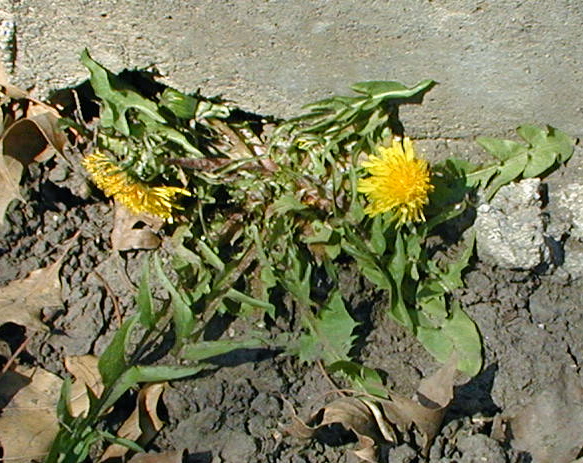
    Dandelions, Taraxacum officinale (sunflower family, Asteraceae) are recognized as the quintessential weed in the United States. They are persistent lawn weeds known to just about everyone, at least in the eastern 2/3 of the United States.

    Everyone hates dandelions. Enormous amounts of time and energy have been spent killing dandelions.

     Dandelions haven’t always been weeds. They were almost certainly brought to the United States intentionally as a food plant. The leaves are edible, eaten raw like lettuce or cooked like spinach. 

Monday, March 25, 2013

Botany Rules 1: Writing Plant Common Names and English Names


August wildflowers, Victoria, Australia
    We have a variety of conventions for writing about plants that aren’t particularly obvious, probably because they lie at the intersection of science, language rules and everyday speech. These frequently mystify and frustrate people who otherwise love plants. I am planning posts that explain the rules as I know them.  This one is about writing plant names.
dandelions
dandelion
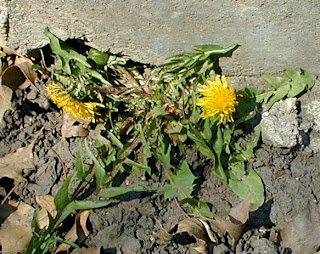
   Most plants have several names--minimally an English common name and a scientific name, but possibly several common names in each of several languages. Thus, the same plant is called: dandelion (English common name), Taraxacum officinale (scientific name)  dent-de-lion, (French common name), achicoria silvestre (Spanish common name) and maskros (Swedish common name). Of course it also has a Dutch, Flemish, German, Italian--you get the picture--
common name as well. In addition, many languages have more than one common name for dandelions, plant books in English might mention blowball, cankerwort, wild endive and piss-i-beds, in Spanish amargon, diente de leon, and taraxacon. I’d say all of those are the plant’s real name:  if, when you use a name, the person to whom you are speaking recognizes it, then that’s the whole point.

Rules for writing common names: modern English doesn’t capitalize common names of plants (or animals, tho bird specialists sometimes do capitalize bird common names).  The plant common name has to conform to the rules of English, however, so if there’s a proper noun in the common name, it must be capitalized.