The little French marigolds (Tagetes patula) that I planted this spring are about at their best. Their flowers are open and few are beyond flowering, maturing seeds.
| French marigolds, Tagetes patula |
The little French marigolds (Tagetes patula) that I planted this spring are about at their best. Their flowers are open and few are beyond flowering, maturing seeds.
| French marigolds, Tagetes patula |
Purslane, Portulaca oleracea, is a worldwide crop and weed (see last week's post link). It has been cultivated for thousands of years in both the Old World and the New. That doesn't make much sense: how did it cross the oceans before Columbus?
| purslane, Portulaca oleracea |
My major professor, Herbert G. Baker, caused a stir in academic botany in 1965 by publishing a list of the characteristics of an "ideal" weed. Since weeds are not popular, an ideal one is a troubling idea.
What Baker did was to look at the characteristics of successful weeds and reduce them to a list, characters of plants highly adapted to reproducing rapidly under any conditions. No real plant has all those characteristics, but some have several.
The paper made me look analytically at troublesome, weedy plants...and reluctantly admire their resilience and productivity. Fifty-seven years later, these are still good ideas.
Facebook gardening groups post pictures of plants found in their yards and ask "Is this a plant or a weed?" Botanically that is a terrible statement because all weeds are plants, though not all plants are weeds. But what the writer meant was, "Is this a desirable or undesirable plant?"
We can identify the plant, and if the property owner didn't plant it, then it will likely be called a weed.
But that is so limited! I'd like at least a third category.
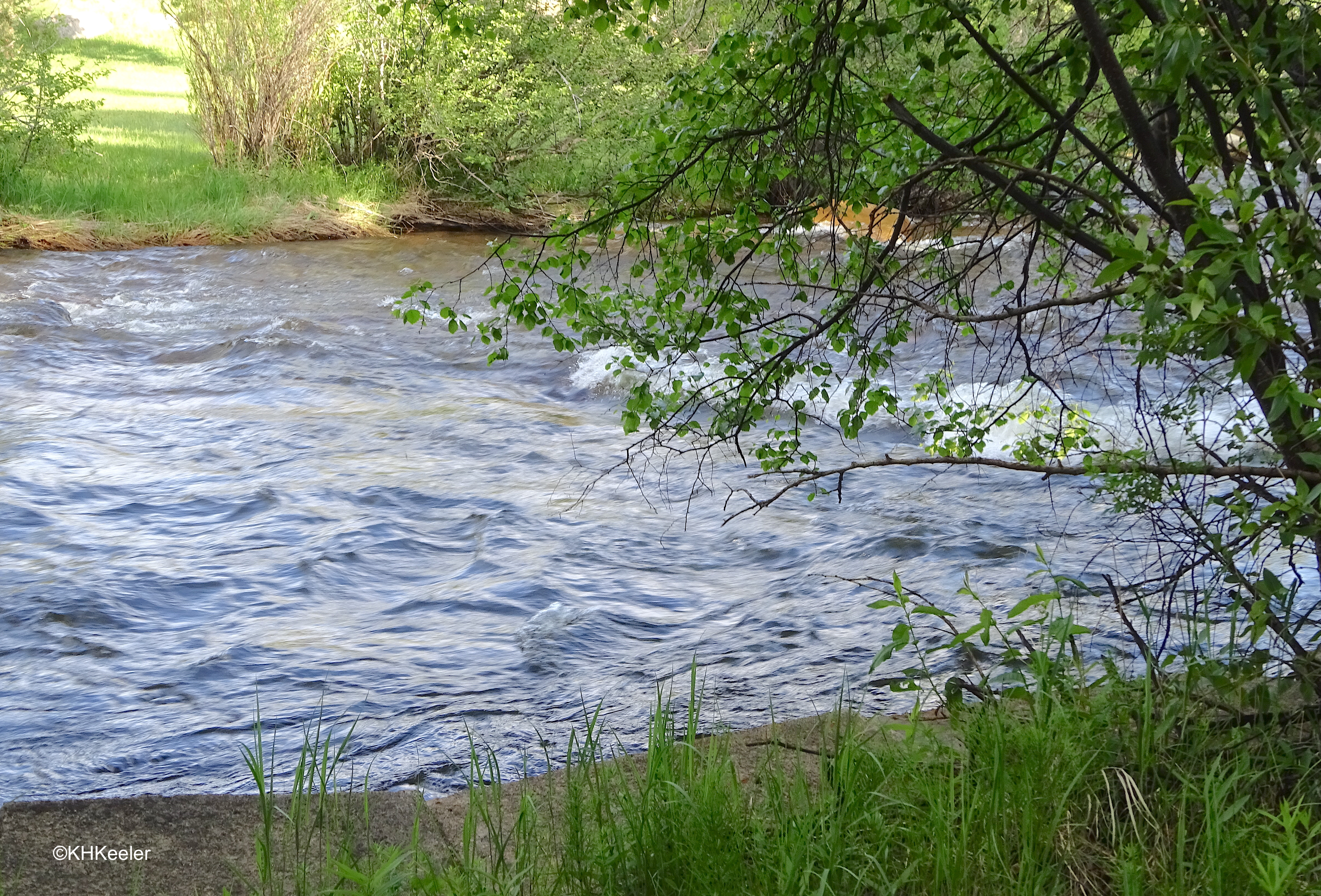
Hiking in Estes Park, Colorado at 7,500' elevation on the east side of the Colorado Rocky Mountains, last June, I climbed a rocky slope and shared the plants and views a couple weeks ago (link). The next day I walked downhill and along a clear, turbulent stream. The plants were quite different.
| Stream, Estes Park, Colorado |
The difference wasn't elevation as much as habitat. The stream provided water in the soil and humidity in the air. These supported leafy trees that cast shade and trapped the water that evaporated off the stream. And finally, streams periodically flood, leaving silt to build and enrich the soil along their banks. So for all these reasons, the streamside plants were different from the hillside plants.
The Victoria water-lily (Victoria amazonica) is a grand plant with 8' diameter leaves and big fragrant white flowers. It caused a stir when it was discovered and the English made it a symbol of Queen Victoria. It made another stir last week when a new publication recognized a giant water-lily in the same genus, Victoria boliviana, with 10' diameter leaves. (Description of discovery and the July 4, 2022 recognition of a third species in the genus Victoria in the previous post: link).
But beyond all that, it is an amazing plant.
| Victoria water-lilies, Urucayli River, eastern Peru the white blob in the center is a flower |